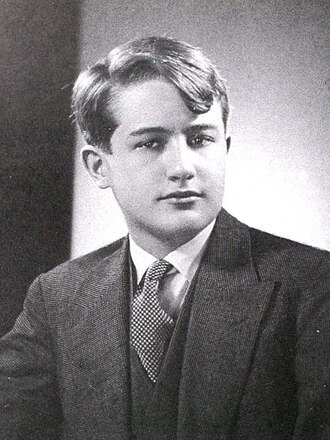
Nicolás Gómez Dávila
1913–1994 · Colombian philosopher and aphorist, critic of modernity
Nicolás Gómez Dávila (Bogotá, 1913 – Bogotá, 1994) was a Colombian thinker who wrote almost his entire work in the form of aphorisms, which he called "escolios" or glosses. Born into an aristocratic family, he is often compared to Nietzsche for the sharpness of his criticism, although he cultivated a deliberately low public profile. His outlook belongs to traditionalist Catholic conservatism and to the broader tradition of anti-modern critique, yet he refused to align himself with the political camps of his time, attacking liberalism, communism and conservatism alike.
From a wealthy background, he spent much of his youth in Paris, where he was educated. A severe bout of pneumonia kept him at home for nearly two years, during which he was taught by private tutors and developed a lasting love of the classics. He never attended a university. He returned to Colombia in the 1930s and, apart from a six-month stay in Europe in 1949, never travelled back to the continent. His life revolved around a personal library of more than 30,000 volumes, now kept in Bogotá. In 1948 he helped found the University of the Andes, and between 1945 and 1947 he served as a member of the Bogotá city council.
His thought rests on a sceptical anthropology, drawing on a close reading of Thucydides and Jacob Burckhardt. He argued that society, the Church and the state should be ordered hierarchically, and he rejected popular sovereignty as a kind of divinisation of man. Like Juan Donoso Cortés, he held that political errors ultimately stem from theological ones, which is why his work can be read as a form of political theology. His main books appeared as aphorisms, notably the series Escolios a un texto implícito, and he described himself as an "authentic reactionary", a figure he set apart from the merely conservative or nostalgic.
His work circulated little during his lifetime. International recognition came late, from the end of the 1980s, through German translations that brought him to the attention of poets and philosophers such as Ernst Jünger and Robert Spaemann. Translations into Italian, French and Polish followed.
Key ideas
- Sceptical anthropology: human beings are limited, and politics must start from that limitation rather than from unlimited faith in progress.
- Hierarchy: society, the state and the Church need ordered structures that give shape to common life.
- Critique of popular sovereignty: the idea that the people is the ultimate source of power seemed to him a way of divinising man.
- Political theology: political errors have theological roots, so the crisis of modernity is also a religious crisis.
- Critique of modernity: liberalism, democracy and Marxism appeared to him as expressions of aesthetic and moral decline.
Curiosities
Deliberate anonymity
He chose not to promote his work. His first books were printed in very small runs, and his writing barely circulated until the German translations appeared.
A library of over 30,000 volumes
His personal library, with more than 30,000 volumes, is one of the most visible parts of his legacy and is kept in Bogotá.
Original Filopedia text based on Wikipedia (es) and Wikipedia (en) and Wikidata.