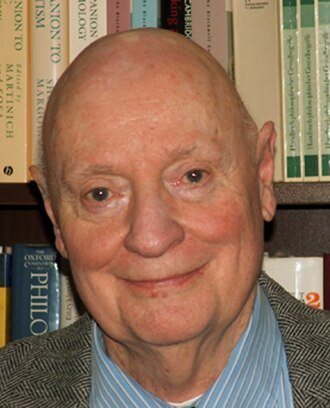
Nicholas Rescher
1928–2024 · German-born American philosopher of pragmatism and idealism
Nicholas Rescher (Hagen, 1928 – Pittsburgh, 2024) was a philosopher born in Germany who spent most of his career in the United States, at the University of Pittsburgh. His work belongs to the analytic and pragmatist traditions, though he described his own position as a synthesis of German and British idealism with American pragmatism.
He moved to the United States at the age of ten. He took a degree in mathematics at Queens College and earned his doctorate in philosophy at Princeton in 1951, at 22. After a period in the Marine Corps and at the RAND Corporation, he joined Pittsburgh in 1961, where he founded the American Philosophical Quarterly and led the Center for Philosophy of Science.
His early research focused on medieval Arabic logic. He then widened his interests to metaphysics, epistemology and a methodological pragmatism shaped by Peirce. His major project, A System of Pragmatic Idealism, offers an account of human knowledge grounded in the limits of finite inquirers. Rescher also worked on forecasting, with the Delphi method, and on Leibniz.
He was one of the most prolific writers in contemporary philosophy, with more than a hundred books. His influence can be seen in formal logic, decision theory and the philosophy of science.
Key ideas
- Pragmatic idealism: human knowledge is understood as a practical construction, limited by our condition as finite inquirers.
- Synoptic tension: we seek useful and comprehensive knowledge, but our capacities restrict it, which gives philosophy its dialectical character.
- Cognitive economy: inquiry must manage scarce resources, so rationality includes choosing what is worth knowing.
- Pluralism: the diversity of philosophical systems is unavoidable and should not be forced into consensus.
- Ignorance and error: recognising what we do not know and what we may get wrong is part of rational knowledge.
Curiosities
An early doctorate
He earned his philosophy doctorate at Princeton in 1951, at 22, the youngest person to do so in that department.
A committee under one name
Because of his vast output, a joke circulated that Rescher was not one person but a committee sharing the name.
Original Filopedia text based on Wikipedia (es) and Wikipedia (en) and Wikidata.