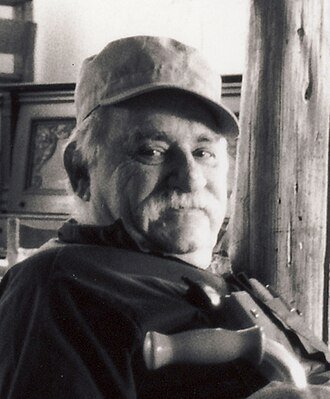
Murray Bookchin
1921–2006 · American anarchist and ecological thinker
Murray Bookchin (New York, 1921 - Burlington, 2006) was an American historian, social theorist and political writer working within the traditions of anarchism and libertarian socialism. He is best known for developing social ecology, one of the first theories to link the environmental crisis with the political and economic structure of society. Largely self-taught and without a college degree, he nonetheless shaped debates in the New Left, the anti-nuclear movement and later experiments such as the democratic confederalism of Rojava.
The son of Jewish immigrants from the Russian Empire, he was drawn to communist youth organisations in the 1930s but grew disillusioned with them by the end of the decade. The Spanish Civil War touched him from afar: he was too young to fight, though some older friends died at the front near Madrid. He worked in foundries and the car industry, and after the great General Motors strike of 1945-46 began to question the idea that industrial workers should be the central agents of revolution. From 1947 he collaborated with German exiles on the magazine Contemporary Issues, where he developed his thinking on technology and decentralisation. His 1962 book Our Synthetic Environment was among the first American works to warn about chemical pollution.
In the 1960s he moved through the counterculture and the New Left. In 1974 he helped found the Institute for Social Ecology in Vermont, which he directed and where he taught for many years. His most ambitious work, The Ecology of Freedom (1982), argues that nature is decentralised and cooperative, and that ecological problems arise when societies adopt hierarchical and authoritarian structures. In his later years he proposed communalism: municipalities run by face-to-face assemblies, linked through confederations and with a municipalised economy, as an alternative both to capitalism and to Marxist state planning. He formally broke with anarchism in 1999. He died of heart failure in 2006, at the age of 85.
Key ideas
- Social ecology: nature and society form a continuum, and environmental problems stem from hierarchical and centralised human relations.
- Anti-hierarchy anarchism: opposition should be aimed not only at the state but at every form of hierarchical domination.
- Libertarian municipalism or communalism: face-to-face assembly democracy at local level, coordinated through confederations of municipalities.
- Appropriate technology: decentralised production on a human scale, as an alternative to productivism and consumerism.
Where to start
The Ecology of Freedom is Bookchin's central work and a natural entry point to his thought. In it he develops social ecology, the idea that many environmental problems stem from hierarchy and domination among people. The reader will find a historical and theoretical vision connecting ecology, politics and freedom.
Next: Post-Scarcity Anarchism. Post-Scarcity Anarchism shows how Bookchin imagines a free and abundant society, applying the ideas of his main work to a concrete political project.
Works in Filopedia
Curiosities
A pen name
His first American book, Our Synthetic Environment, appeared in 1962 under the pseudonym Lewis Herber, a few months before Rachel Carson's Silent Spring.
A name he disliked
He was embarrassed by his given name, Mortimore, and went by his childhood nickname, Murray.
Original Filopedia text based on Wikipedia (es) and Wikipedia (en) and Wikidata.