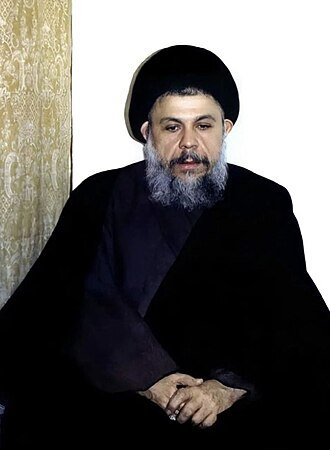
Muḥammad Bāqir aṣ-Ṣadr
1935–1980 · Shia cleric and Iraqi philosopher, ideological founder of the Islamic Dawa Party
Muhammad Baqir al-Sadr (Kadhimiya, 1935 – Baghdad, 1980) was a Shia cleric and Iraqi philosopher, widely regarded as the leading Shia thinker of his generation. Beyond philosophy, he worked as a Quranic exegete, historian and writer on politics and economics. His attempt to connect classical Islamic learning with modern debates has kept his work influential in political Islam and Islamic economics.
He came from a prominent Shia family with roots in Jabal Amel, in what is now Lebanon. His father died in 1937, leaving the household in hardship. In 1945 the family moved to Najaf, the holy city where al-Sadr would spend the rest of his life. He was regarded as a precocious child, and by eleven he had begun formal study of logic. In 1955 he published his first historical work, on the dispute over the land of Fadak. He studied under Abu al-Qasim al-Khoei and Muhsin al-Hakim and began teaching at a young age.
His philosophical and economic writings responded to the spread of Marxism in Iraq. Falsafatuna (Our Philosophy) challenged materialism and communist ideas, while Iqtisaduna (Our Economics) set out an Islamic economic system positioned between capitalism, which he faulted for its lack of morality, and communism, which he believed subordinated individual rights to society. He opposed interest-based banking and argued that Islam does not sanction profit earned without labour. In political theory he held that khilafa, the responsibility of governance, belongs to humanity as a whole, while the scholars bear a role of witness and oversight.
His political activity led him to help found the Islamic Dawa Party, which opposed the Baathist regime. Internal tensions within the party, along with the repression under Saddam Hussein, marked his final years. He was imprisoned several times and, in April 1980, was executed together with his sister Bint al-Huda. His death made him a martyr for many Shia, and his legacy remains visible in contemporary Shia political thought and Islamic finance.
Key ideas
- Khilafa and shahada: governance is a responsibility given to all of humanity, while witness belongs to the prophets, the imams and, during the occultation, to the scholars.
- Critique of capitalism and communism: both systems were rejected for lacking a moral foundation; Islam, in his view, balances individual interest with spiritual principles.
- Prohibition of riba: usury, whether in interest-bearing loans or in trade, should be condemned, because profit must come from one's own labour.
- Marja' as guide: the marja' guides the faithful and watches over deviations from the right path, especially under oppression.
- Islamic democracy: government should be chosen by the people, and Islamic theory rejects monarchy and dictatorship.
Where to start
Falsafatuna, published in 1959, is the best entry point into al-Sadr's thought. It arose as a response to the rise of communism among Iraq's secular youth and examines, from an Islamic perspective, the great philosophical questions and their relation to the materialist ideas of the time.
Next: Our Economy (Iqtisaduna). Our Economics, from 1961, applies the same approach to the economic field and is the natural next step to see how his intellectual project becomes a concrete social system.
Works in Filopedia
Curiosities
A precocious child
By the age of eleven he had begun formal study of logic, according to accounts of his youth.
Executed with his sister
He was executed in April 1980 together with his sister Bint al-Huda, and both were buried that same night in the Wadi-us-Salaam cemetery in Najaf.
Original Filopedia text based on Wikipedia (es) and Wikipedia (en) and Wikidata.