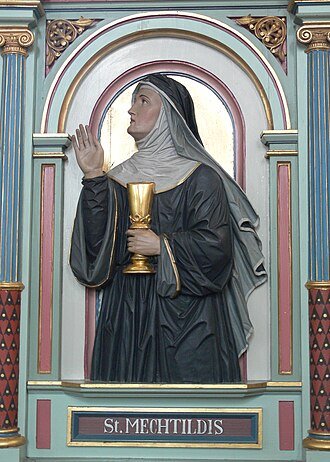
Mechthild of Magdeburg
1207–1282 · German medieval mystic, Beguine and Cistercian nun
Mechthild of Magdeburg (c. 1207–c. 1282) was a German mystic of the Middle Ages who lived first as a Beguine and later in the Cistercian monastery of Helfta. She matters because she was among the first to write a mystical book in Middle Low German, the everyday language of northern Germany, at a time when religious learning was almost always written in Latin.
She was probably born into a noble Saxon family, as scattered hints in her work suggest, and she reported her first vision at the age of twelve. Around 1230 she left home to become a Beguine in Magdeburg, where she seems to have held a position of authority in her community. There she became close to the Dominicans and joined them as a tertiary; her Dominican confessor, Henry of Halle, encouraged her to write down her revelations. Her criticism of church leaders and her claims to theological insight provoked strong opposition, and some called for her writings to be burned. In old age, and blind, she joined the Helfta monastery around 1272, which gave her protection and support in her final years.
Her main work, The Flowing Light of the Godhead, grew over some thirty years into seven books. It mixes visions, prayers, dialogues and accounts of mystical experience in a vivid, highly sophisticated style. Some scholars think her images of Hell influenced Dante's Divine Comedy, though there is no firm evidence for this. The original text is lost; it survives through a Latin translation made by Dominicans of Halle around 1290 and a Middle High German version by Henry of Nördlingen.
The book was largely forgotten by the fifteenth century and was rediscovered in the late nineteenth century, when Pater Gall Morel published the first edition. It is now studied both as a work of medieval thought and as devotional literature, and she is remembered as an early champion of German as a language fit for the sacred.
Key ideas
- Love as the path to God: mystical experience is presented as an intimate, loving encounter with the divine rather than as abstract knowledge.
- The flowing divine light: God reveals himself in a dynamic, continuous way, and the soul receives and returns that light in a movement of mutual giving.
- Criticism of church hierarchy: she denounced corruption and pride among church leaders with a prophetic voice that earned her many enemies.
- The authority of lived experience: she held that her knowledge came from direct revelation, which led her to defend a theology grounded in personal experience.
Curiosities
A writer in the vernacular
She wrote in Middle Low German at a time when most wisdom literature was composed in Latin.
A vision at twelve
According to her own account, she had her first vision of the Holy Spirit at the age of twelve.
Original Filopedia text based on Wikipedia (es) and Wikipedia (en) and Wikidata.