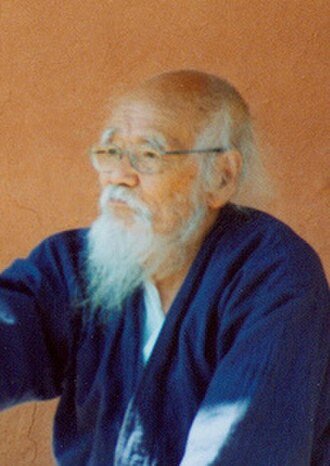
Masanobu Fukuoka
1913–2008 · Japanese farmer, biologist and philosopher
Masanobu Fukuoka (1913 – 2008) was a Japanese farmer, biologist and philosopher, best known for his advocacy and practice of what he called natural farming. His thinking matters because it challenged the idea that growing food requires constant ploughing, fertilising, spraying and tilling, and proposed a way of cultivating that works with the processes of the ecosystem rather than against them.
He came from a family of farmers with a long history on the land. He trained as a scientist in soil science and plant pathology and worked in agricultural research, but around 1937, after a bout of pneumonia and what he later described as a profound spiritual experience, he began to doubt modern agronomy. He left his research post and returned to the family farm on Shikoku island, where he grew mikan citrus without chemicals. During the war he worked at an agricultural experiment station. After postwar land reform took most of the family's holdings, he resumed natural farming and made it work. In 1975 he published The One-Straw Revolution, translated into English in 1978, which became his best-known book. From 1979 he travelled widely, giving lectures and taking part in projects to re-vegetate desertified land in Africa, Asia and Europe.
His method rests on four principles: no ploughing or tilling, no prepared fertilisers or compost, no weeding by machine or herbicide, and no pesticides. Behind them lies a Taoist and Zen idea, wu wei, or non-doing, which treats human intervention as something to be kept to a minimum. To sow, he developed clay seed balls, which mix seeds with clay and are scattered over the field; the first heavy rain breaks them open and the seedlings emerge protected. He argued that the soil would regenerate over time and crops would improve while labour fell. For Fukuoka, farming was not only about producing food but also a path toward human cultivation and perfection.
His influence was considerable in the organic farming movement and in permaculture, and his book has been translated into more than twenty languages. Not all of his methods transfer easily to every farm: the writer Wendell Berry noted that many of his techniques were not directly applicable to most American farms, though he thought it would be a mistake to dismiss the practical passages of the book. Even so, his work remains a reference for those seeking farming with fewer inputs and closer attention to natural cycles.
Key ideas
- No ploughing or tilling: keeping the soil structure intact protects its moisture and its microorganisms.
- No fertilisers or pesticides: fertility is regenerated through interactions among the plants, animals and minerals of the land itself.
- Wu wei, or non-doing: intervene as little as possible and let natural cycles work in the crop's favour.
- Clay seed balls (nendo dango): mixing seeds with clay allows sowing without a plough and with fewer losses to animals and weather.
Works in Filopedia
Curiosities
A change of course after an illness
He later said that the pneumonia he suffered in 1937 brought a spiritual experience that changed his view of the world and led him to leave research.
A rice the government wanted to buy
The Japanese government offered to buy exclusive rights to his rice, which he grew without the traditional flooding of fields. Fukuoka refused.
A grant returned
In 1998 he received a grant of 10,000 dollars from the Rockefeller Brothers Fund, but returned it because his advanced age prevented him from completing the project.
Original Filopedia text based on Wikipedia (es) and Wikipedia (en) and Wikidata.