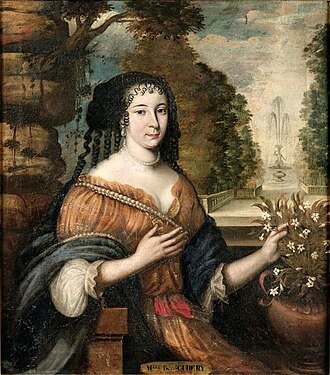
Madeleine de Scudéry
1607–1701 · French writer and salon hostess of the 17th century
Madeleine de Scudéry (Le Havre, 1607 – Paris, 1701) was one of the most influential literary figures of 17th-century France. Often known as Mademoiselle de Scudéry, she is regarded as the first woman of letters in France and, in her own time, in the world. Her work belongs to the movement of préciosité, which sought to refine language and the manners of polite society, and she became one of its best-known representatives.
She was born in Le Havre, in Normandy, into a family without wealth. Her father, captain of the port, died in 1613, and her mother soon after. Her uncle took charge of her and gave her an unusually broad education for a woman of her time, covering writing, drawing, dancing, painting and needlework, and, on her own initiative, agriculture, medicine, cookery, Spanish and Italian. Around 1637, after her uncle's death, she settled in Paris with her brother Georges de Scudéry, a playwright, and at times she published under his name. She frequented the Hôtel de Rambouillet before opening her own salon, known as the Saturday Society, where leading figures of the age gathered for learned and courtly conversation. She often used the pseudonym Sapho, a fashion of the day. Her close bond with Paul Pellisson lasted until his death in 1693, and she never married.
Her long novels are the heart of her output, among them Ibrahim, Artamène ou le Grand Cyrus, Clélie, Almahide and Mathilde d'Aguilar. They are set in antiquity or the Orient, yet their characters, dressed as classical heroes, offered recognisable portraits of her contemporaries. Artamène, at roughly two million words, ranks among the longest novels ever published. Its plots move through lengthy conversations, and Clélie contains the famous map of love known as the Carte de Tendre, in which rivers and villages stand for stages of a relationship. Her fiction explores feelings such as melancholy, restlessness and boredom, and anticipates later sensibilities associated with Rousseau. Her conversations, gathered in later volumes such as Morale du monde, became a sort of handbook for elegant social life.
Her thought has a distinctive emphasis on conversation and on female education as routes to intellectual influence. She adapted classical rhetoric to the practice of the salon, where speech builds on what others have said and aims at agreement rather than dispute. In Artamène she voiced a clear distrust of marriage, which her heroine Sapho calls a form of tyranny. Some critics read the novel as a reflection on the situation of women after the Fronde, when their intellectual role was pushed into private life. She was the first woman to win the eloquence prize of the Académie française.
She outlived her brother by more than thirty years and, in her last period, collected many of her conversations into print. Her influence reached writers such as La Fontaine, and Molière mocked the excesses of préciosité in Les Précieuses ridicules, a play in which some have seen allusions to her. Late in life she is said to have been deaf for around forty years. Her reputation faded as literary tastes changed, but modern criticism has revisited her as a thinker of conversation and of women's voices in the culture of her age.
Key ideas
- Conversation as a mode of thought: the salon dialogue, based on wit and agreement, is a legitimate space for reflection and knowledge.
- Women's education: intellectual formation gives women a route to social influence and to participation in literary culture.
- A refined ideal of love: her novels present love as an emotional and social process, mapped into stages and complex feelings.
- Critique of marriage: in Artamène, the heroine Sapho considers marriage a form of tyranny.
- The novel as social portrait: classical or Oriental fiction serves as a veiled picture of contemporary society.
Works in Filopedia
Curiosities
A borrowed name
She often published under the name of her brother Georges, and she frequently used the pseudonym Sapho in her works.
A record-length novel
Artamène, ou le Grand Cyrus, at about two million words, ranks among the longest novels ever published.
Original Filopedia text based on Wikipedia (es) and Wikipedia (en) and Wikidata.