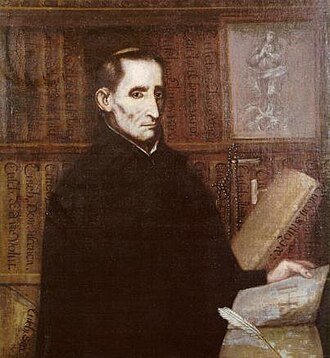
Juan Eusebio Nieremberg
1595–1658 · Spanish Jesuit, humanist and ascetic writer
Juan Eusebio Nieremberg (Madrid, 1595 – Madrid, 1658) was a Spanish Jesuit, humanist and ascetic writer of the Spanish Golden Age. The son of a Tyrolese father and a Bavarian mother, both connected to the court of Maria of Austria, he embodied the meeting point of natural science, theology and devotional literature in Baroque Spain.
He studied at the Jesuit Colegio Imperial in Madrid and then at Salamanca. Against strong family opposition, he joined the Society of Jesus in 1614. He was ordained a priest in 1623 and made his solemn profession in 1633. For years he taught humanities and natural science at the Colegio Imperial, later adding Sacred Scripture to his courses. As a confessor he gained a certain standing at court, and he took part in doctrinal debates on the Immaculate Conception.
His thought was eclectic, blending scholastic philosophy with Platonic, Stoic and Kabbalistic elements while remaining within Catholic orthodoxy. In his natural histories he moved away from Aristotelian physics towards a corpuscular view of matter, and his treatise on music defended its healing powers. His lasting reputation, however, rests on his ascetic writing. Works such as Diferencia entre lo temporal y eterno (1640) went through many reprints and translations and influenced later writers, including Jacinto Verdaguer. His clear, brilliant Baroque prose is still studied today.
Key ideas
- Eclecticism: a blend of scholasticism, Neoplatonism and other traditions, always subordinated to Catholic dogma.
- Nature and physics: he explained natural phenomena in an atomist spirit, partly departing from Aristotle.
- Asceticism: reflection on the temporal and the eternal as a path to disillusionment with the world and spiritual perfection.
- Divine love: God's beauty and goodness as the centre of spiritual life.
Curiosities
Fame beyond Spain
His book Diferencia entre lo temporal y eterno went through many reprints and translations, and it is said to have inspired Jacinto Verdaguer's poem La Atlántida.
A plant genus named after him
The botanists Ruiz and Pavón named the plant genus Nierembergia after him in their Flora Peruvianae et Chilensis Prodromus (1794).
Original Filopedia text based on Wikipedia (es) and Wikipedia (en) and Wikidata.