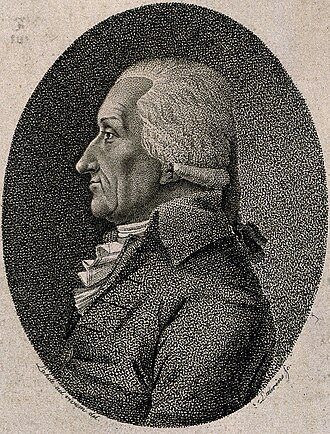
Johannes Nikolaus Tetens
1736–1807 · German-Danish philosopher and actuary of the Enlightenment
Johannes Nikolaus Tetens (1736-1807) was a German-Danish philosopher, mathematician and scientist of the Enlightenment. He is often called the "German Locke" and is regarded as one of the leading figures of German Enlightenment thought, as well as an influence on Immanuel Kant.
He studied mathematics and physics at Rostock and Copenhagen, earning his master's degree in 1759 and his doctorate in 1760. He then taught philosophy and natural philosophy at the newly founded academy in Bützow, where he wrote essays on topics ranging from the colour of the sky to the existence of God. In 1776 he moved to the University of Kiel, where he taught until 1789, when he settled in Copenhagen and entered the Danish civil service.
His main work, the Philosophical Essays on Human Nature and Its Development (1777), tried to join Hume's empiricism with the German academic tradition of Leibniz and Wolff. Tetens proposed a psychological analysis of the mind carried out with methods close to those of the natural sciences, and he drew a clear line between thought, feeling and will. His contemporaries called him the "German Hume". His influence on Kant was considerable, particularly in how the relation between sensibility and the faculties of the mind was framed.
Tetens also became a pioneer of actuarial science. His treatise on life annuities, published in Leipzig in 1785 and 1786, synthesised earlier work in the field and offered one of the first measures of risk used by actuaries.
Key ideas
- Psychological analysis of the mind: the faculties of the soul should be studied with an empirical method resembling that of the natural sciences.
- Distinction of faculties: Tetens was among the first to separate thought, feeling and will as distinct capacities of the mind.
- Empiricism with a rationalist inheritance: he sought to combine Hume's critique of causal knowledge with the legacy of Leibniz and Wolff.
- Phenomenalism: experience is understood as a set of representations rather than direct access to things in themselves.
Teachers and influences
Influenced
- Immanuel Kant 1724–1804
Original Filopedia text based on Wikipedia (es) and Wikipedia (en) and Wikidata.