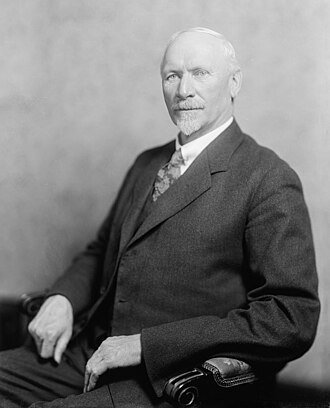
Jan Christiaan Smuts
1870–1950 · South African statesman, soldier and philosopher
Jan Christiaan Smuts (born 24 May 1870 in the Cape Colony, died 1950) was a South African statesman, military officer and philosopher. He served as Prime Minister of the Union of South Africa in two periods, and he played a leading part in creating the League of Nations and the United Nations. He is best remembered for politics, but he also left a distinctive mark on philosophy through holism, a term he introduced and which he tried to apply to evolution and personality.
He was born to Afrikaner farming parents in the Cape Colony. As the second son, he was expected to stay on the family farm, but the death of his elder brother in 1882 sent him to school. He studied at Stellenbosch, where he learned Dutch, German and Ancient Greek, and then at Cambridge, where he read law at Christ's College. There he wrote a study of Walt Whitman that was not published in his lifetime, though it is seen as an early sketch of his later holistic thinking. He returned to the Cape Colony around 1895 and combined law with journalism and politics.
His career soon became entangled with that of Cecil Rhodes, who hired him as legal adviser. After the Jameson Raid he broke with Rhodes and entered the service of Paul Kruger's South African Republic as state attorney. He tried to avert war at the Bloemfontein conference, but his clash with Alfred Milner helped bring the talks to nothing, and he then fought in the Second Boer War. After the conflict he worked with Louis Botha to form the Union of South Africa in 1910. During the First World War he led campaigns in East Africa and sat on the British Imperial War Cabinet.
His philosophical work centres on holism, set out in Holism and Evolution (1926). Smuts argued that reality, from matter to life and mind, is organised into wholes that cannot be explained simply by adding up their parts, and that evolution tends to produce ever more complex and integrated forms. In politics he championed international cooperation, which led him to push for the League of Nations and to draft the preamble of the UN Charter. His stance on race was contradictory: he opposed extending apartheid in the 1930s, yet he supported segregation, and late in life he backed the Fagan Commission's proposals to ease restrictions on Black South Africans in cities. His influence endures in debates about holism, in the Commonwealth, and in the discussion of a statesman who championed international peace while also defending an unequal racial order.
Key ideas
- Holism. Reality is organised into wholes that cannot be explained merely as the sum of their parts.
- Holistic evolution. Evolution tends to produce ever more complex and integrated forms.
- Personality as a whole. Personality should be studied as a totality, not only through its isolated traits.
- International cooperation. Lasting peace requires supranational institutions such as the League of Nations and the United Nations.
Curiosities
A Cambridge tribute
In 1970, the Master of Christ's College, Lord Todd, said that in 500 years of the college's history only three members had been truly outstanding: John Milton, Charles Darwin and Jan Smuts.
The most brilliant student
Frederic William Maitland, one of his tutors and a leading English legal historian, described Smuts as the most brilliant student he had ever met.
A book published after his death
His study of Walt Whitman was not published until 1973, twenty-three years after his death.
Original Filopedia text based on Wikipedia (es) and Wikipedia (en) and Wikidata.