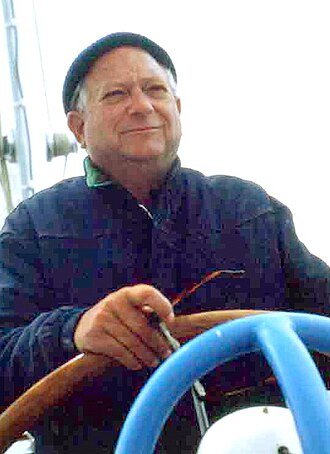
Jack Vance
1916–2013 · American writer of science fiction, fantasy, and mystery
John Holbrook Vance, known as Jack Vance (San Francisco, 1916 – Oakland, 2013), was an American writer of science fiction, fantasy, and mystery fiction. He published under several pen names, including Peter Held and Alan Wade, and wrote three mystery novels under the Ellery Queen name. His first stories appeared in pulp magazines in the mid-1940s, and his output eventually exceeded sixty books.
He grew up in San Francisco and then, after his parents separated, on his maternal grandparents' ranch near Oakley in the Sacramento River delta. There he read his mother's large book collection, which included Verne and Burroughs, and the pulp magazines he found at the local drugstore. The death of his grandfather, during the Great Depression, left the family in financial trouble, and Vance worked many jobs before enrolling at the University of California, Berkeley.
He worked as an electrician at Pearl Harbor and left the job about a month before the Japanese attack. He then joined the Merchant Marine after memorizing an eye chart to pass the vision test. In the 1950s he wrote scripts for the television series Captain Video and spent long periods travelling in Europe, Ireland, Tahiti, and Kashmir, places where he wrote many of his stories and novels.
His style is known for dry irony and for suggesting strange, alien, yet recognisably human beings in only a few sentences. He enjoyed stories within stories, footnotes, and glossaries of untranslatable terms that readers piece together without being spelled out. His recurring themes include individualism, scepticism toward religious dogma, and the critique of decadent aristocracies that cannot face practical problems.
His legacy is considerable. He won the Edgar Award in 1961 for best first mystery novel, and two Hugo Awards, for The Dragon Masters and The Last Castle, which also earned him the Nebula. In 1997 the Science Fiction and Fantasy Writers of America named him a Grand Master, and in 2001 he was inducted into the Science Fiction Hall of Fame. Later writers, including George R. R. Martin, have cited him as a major influence.
Key works
- The Dying Earth (1950): linked stories that gave their name to a decaying, post-apocalyptic setting.
- The Dragon Masters (1963): a science fiction novel that won the Hugo Award.
- The Last Castle (1966): a novel about an aristocratic society that has lost the ability to face practical realities, winner of the Hugo and Nebula Awards.
Where to start
The Dying Earth is the ideal entry point to Jack Vance: a speculative fantasy series whose stories and novels, with a witty tone and strange worlds, show his agile style and boundless imagination. Its early volumes offer adventures that require no prior knowledge.
Next: The Lyonesse Trilogy. The Lyonesse Trilogy, set in the mythical Elder Isles, is a natural next step for readers who want to keep exploring Vance's elegant, richly nuanced fantasy.
Works in Filopedia
Curiosities
A job before Pearl Harbor
He worked as an electrician at Pearl Harbor, Hawaii, and left about a month before the Japanese attack.
A memorized eye chart
In 1943 he memorized an eye chart to pass the vision test and become an able seaman in the Merchant Marine, despite his weak eyesight.
An award for a mystery
The 1961 Edgar Award for best first mystery novel went to The Man in the Cage, one of his books in the crime genre.
Teachers and influences
Influenced by
- James Branch Cabell 1879–1958
Influenced
- Ursula K. Le Guin 1929–2018
- Terry Pratchett 1948–2015
- Michael Chabon b. 1963
- Michael Moorcock b. 1939
- Dan Simmons 1948–2026
- Robert Silverberg b. 1935
- China Miéville b. 1972
- Gary Gygax 1938–2008
- Gene Wolfe 1931–2019
Original Filopedia text based on Wikipedia (es) and Wikipedia (en) and Wikidata.