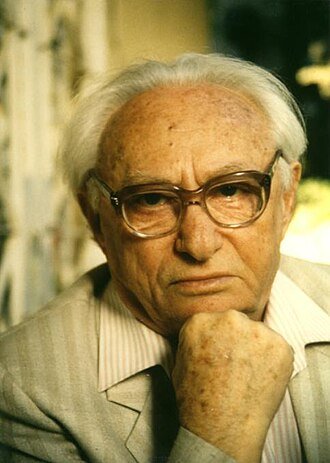
Israel Eldad
1910–1996 · Israeli political philosopher, writer and ideologue of the Lehi underground
Israel Eldad (born Israel Scheib; Pidvolochysk, Galicia, 1910 – Jerusalem, 1996) was a political philosopher, writer and the main ideologue of the Lehi underground movement in Mandatory Palestine. His thought belonged to the Revisionist strand of Zionism, which demanded full Jewish sovereignty over the Land of Israel against British policy.
Raised in a traditional Jewish home and shaped by the wartime displacement and pogroms he saw as a boy, he studied at a rabbinical seminary and at the University of Vienna, where he earned a doctorate on the voluntarism of Eduard von Hartmann. In Poland he was active in Betar and defended Menachem Begin, with whom he fled Warsaw in 1939. He immigrated to Palestine in 1941 and, living underground under aliases such as "Sambatyon" and "Eldad", became one of three Lehi commanders after Avraham Stern's death. Arrested by the British, he escaped from custody in 1946.
Eldad did not regard the state of Israel as the final aim of Zionism. He saw it as a tool for achieving what he called the Kingdom of Israel: sovereign Jewish rule within the biblical borders, with the Temple rebuilt in Jerusalem. He denied legitimacy to Jewish life in the Diaspora, yet viewed exiled generations as active agents of history rather than passive sufferers.
After the 1948 war he sat in the Knesset for the Fighters' List, taught at the Technion, and for fourteen years edited the journal Sulam. Much of his work, largely translated by Zev Golan, remains a reference point for Israeli nationalism, and in 1988 he received the Bialik Prize for Jewish thought.
Key ideas
- National redemption: Zionism's goal is a sovereign Jewish kingdom within the biblical borders, with the state serving only as a means.
- Diaspora: Jewish life outside the Land of Israel was doomed to extinction, though exiled Jews were active players in history.
- Philosophy of history: the Jewish past is a creative process leading toward national redemption, shaped by influences from Nietzsche and Schopenhauer.
- Rebuilding the Temple: restoring the Temple in Jerusalem was central to his political and religious vision.
Curiosities
Disguised as a foreign journalist
Near the end of the 1948 war, he disguised himself as a foreign journalist to slip past Israeli military roadblocks and join the battle for Jerusalem.
A chess game interrupted
According to the account, Soviet police arrested Begin in the middle of a chess game with Scheib, and several years passed before they met again.
Original Filopedia text based on Wikipedia (en) and Wikidata.