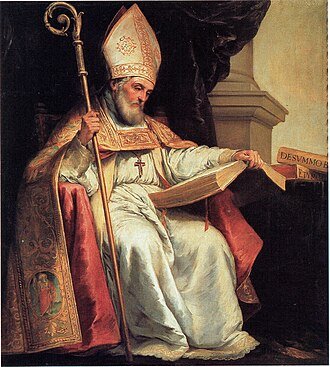
Isidore of Seville
560–636 · Hispano-Roman scholar, theologian and archbishop of Seville
Isidore of Seville (c. 560 - Seville, 4 April 636) was a bishop of Seville for more than three decades and is widely regarded as the last great scholar of the ancient world in the West. Venerated as a saint by both the Catholic and Orthodox Churches, he is often called the last Father of the Western Church. He lived in the Visigothic kingdom at a time when classical culture was declining, aristocratic violence was common and literacy was rare, and his work proved decisive in carrying ancient learning into the Middle Ages.
He came from a Hispano-Roman Catholic family of standing. His father was called Severianus, and his siblings included Leander, bishop of Seville, Fulgentius, bishop of Astigi, and Florentina, a nun. Tradition places his birth in Cartagena, though some scholars think the family was already living in Seville by then. He was educated at the cathedral school of Seville, where he learned classical Latin, some Greek and Hebrew, and the liberal arts. After Leander's death in 600 or 601 he succeeded him in the see. From there he worked to move the Visigothic kings from Arianism to Catholicism, opposed heresy and pressed for discipline among the clergy and better training for future priests.
His relations with the kings were close. King Sisebut encouraged him to write works such as De natura rerum and his histories of the Goths, and King Sisenand turned to him to convene the Fourth Council of Toledo in 633, which Isidore led. The council required every bishop to found a seminary modelled on the one at Seville, and it promoted the study of Greek, Hebrew, the liberal arts, law and medicine. His most influential work is the Etymologiae, an encyclopedia in twenty books that preserved passages from countless ancient authors who would otherwise be lost. His friend Braulio of Zaragoza probably helped to circulate the text in its final form. The book became the most widely owned compendium in medieval libraries, and it kept much classical learning alive, although Isidore relied heavily on his sources and knew Greek only to a limited degree.
His influence lasted through the Middle Ages and the Renaissance, with numerous printed editions between 1470 and 1530. The Etymologiae provided a model for medieval encyclopedias, transmitted ideas from Aristotle and other Greek thinkers before translations from Arabic arrived, and left a mark on the bestiary tradition. He also served as a bridge between the ancient world and medieval Europe, and his work of gathering and organising knowledge secured him a lasting place in the history of Western culture.
Key ideas
- Etymology as a route to knowledge: the meaning of a word is revealed by its origin, so he arranged learning around the terms themselves.
- Encyclopedic knowledge: in the Etymologiae he gathered the sum of accessible learning of his time, from grammar to medicine, in twenty books.
- Religious and cultural unity: he sought to join Roman and Gothic inheritances into a single Catholic nation, opposing Arianism.
- Training of the clergy: he held that future clerics needed a solid grounding in the liberal arts and languages, and he promoted seminaries to provide it.
Where to start
History of the Kings of the Goths, Vandals and Suevi
It is a brief, direct chronicle covering the history of the Goths, Vandals and Suevi from 265 to 624. It gives the reader a condensed account of kings, wars and successions, in the voice of a chronicler who seeks to give context to the Hispania of his own time.
Next: Etymologies. The Etymologies broaden Isidore's view to the whole of knowledge, explaining the origins of words across nearly every discipline of his age..
Works in Filopedia
Curiosities
A treatise on the library
In the Etymologiae he described how a library should look: a room with green panelled ceilings, a marble floor and portraits of the best authors of each discipline.
A work that replaced others
Braulio of Zaragoza said the book contained almost everything one needed to know, and its success meant many classical texts were no longer copied and were lost.
Original Filopedia text based on Wikipedia (es) and Wikipedia (en) and Wikidata.