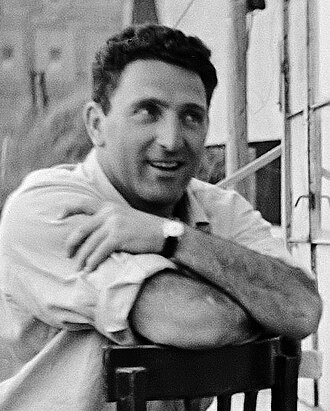
Irwin Shaw
1913–1984 · American playwright, screenwriter, novelist and short-story writer
Irwin Shaw (New York, 1913 – Davos, Switzerland, 1984) was an American writer who worked across theatre, radio, film, the novel and the short story. Born Irwin Gilbert Shamforoff in the South Bronx to Jewish immigrants from Ukraine, he became one of the most widely read American writers of the postwar decades, with a body of work that tracked ordinary middle-class lives and the political pressures of the Cold War.
The family moved to Brooklyn shortly after his birth, and Shaw changed his surname when he went to college. He graduated from Brooklyn College in 1934 and the following year began writing scripts for radio shows such as Dick Tracy, The Gumps and Studio One. His first play, Bury the Dead, is an expressionist drama about soldiers killed in battle who refuse to be buried. In the 1940s he also worked in Hollywood, and his first novel, The Young Lions, published in 1948, drew on his own time in Europe as an officer during the Second World War.
After being placed on the Hollywood blacklist over alleged communist sympathies in the early 1950s, Shaw left the United States in 1951 and lived in Europe for about a quarter of a century, mostly in Paris and Switzerland. There he wrote much of his fiction, including broad social novels such as Lucy Crown and Rich Man, Poor Man, as well as short stories that earned him a strong reputation with readers of magazines like The New Yorker and Playboy.
His writing is marked by a plain, close realism that attends to the moral choices of ordinary people and to the way history reaches into private lives. Rich Man, Poor Man, about two brothers and a sister in the decades after the war, became a hugely popular television miniseries in 1976 and spawned sequels. Shaw died in Davos at the age of 71, after treatment for prostate cancer. His legacy rests mainly on his best-selling novels and his short fiction, which are still read as chronicles of twentieth-century American society.
Key works
- The Young Lions (1948), a novel following three soldiers through the Second World War.
- The Troubled Air (1951), a novel about the rise of McCarthyism and blacklisting in the entertainment industry.
- Rich Man, Poor Man (1970), a postwar family saga that inspired the famous 1976 miniseries.
- The Top of the Hill (1979), a novel set around the Winter Olympics.
- Bread Upon the Waters (1981), a realist novel about the economic and social life of twentieth-century New York.
Where to start
Rich Man, Poor Man 1970
It is an accessible novel that portrays, with the pace of a family saga, the opposing lives of two brothers in postwar American society. Readers will find well-drawn characters, lively dialogue and a critical look at money, social ascent and the moral choices that shape a family.
Next: Bury the Dead. After the novel, his play Bury the Dead shows Shaw's more direct antiwar vein, in a brief work with strong expressionist force.
Works in Filopedia
Curiosities
A change of name
Shaw was born Shamforoff and changed his surname when he entered university. He published all of his later work under the new name.
A widely read storyteller
Sixty-three of his stories were collected in 1978 as Short Stories: Five Decades, and three were dramatized for the PBS series Great Performances.
Original Filopedia text based on Wikipedia (es) and Wikipedia (en) and Wikidata.