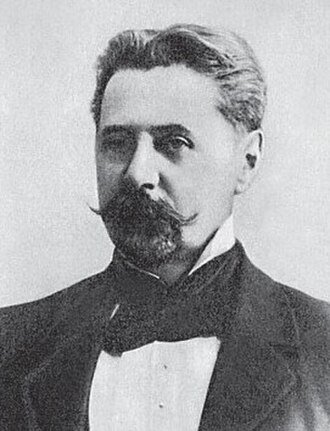
Innokenty Annensky
1855–1909 · Russian poet, critic and translator
Innokenty Annensky (Omsk, 1855 - Saint Petersburg, 1909) was a Russian poet, critic and translator and a leading figure of the first wave of Russian Symbolism. Writing in Russian but steeped in French poetry, he is often compared to the French poètes maudits. He matters because he linked Symbolism to the generation of poets that followed.
Born in Omsk into the family of a minor public official, he was taken to Saint Petersburg while still a child. After losing his parents he was raised by his older brother Nikolai, a prominent Narodnik activist. He graduated in philology from St. Petersburg University in 1879, focusing on historical-comparative linguistics. For years he taught classical languages and ancient literature at a gymnasium in Tsarskoe Selo, serving as its director from 1886 until his death.
Annensky was reluctant to publish his own verse, and he first earned his reputation through translations of Euripides and the French Symbolists. At the start of the twentieth century he wrote tragedies modelled on those of ancient Greece, and he produced critical essays on Russian and European writers. In his final months he worked as an editor for Sergei Makovsky's journal Apollon, where he published reflections on poetic theory. His poetry is marked by pessimism, seeing life as a wicked enchantment that ends in death. His first book appeared in 1904 under a pseudonym, and his second, The Cypress Chest, came out shortly before he died suddenly at the Tsarskoe Selo railway station.
His legacy is twofold. Many unpublished poems were released posthumously in the 1920s, and his reputation grew considerably after that. He also influenced the Acmeists and post-Symbolists, including Anna Akhmatova, Osip Mandelstam and Nikolai Gumilev, who regarded him as a key precursor. Today he is remembered above all as a poet.
Key works
- Quiet Songs (1904): his first book, published under a pseudonym, with a somber and musical tone.
- The Cypress Chest (1910): his best known poetry collection, released shortly before his death.
- Melanippe the Wise (1901): a tragedy modelled on ancient Greek drama that opens his dramatic cycle.
- Book of Reflections (1906): a collection of critical essays on Russian and European writers.
Curiosities
A poet who did not publish
Following his brother's advice, he published nothing until he was thirty-five. His first book appeared under the pseudonym Nik. T-o, which means "Nobody" in Russian.
An asteroid named after him
In 1979 the asteroid 3724 Annenskij, discovered by Soviet astronomer Lyudmila Zhuravlyova, was named in his honour.
Teachers and influences
Influenced
- Anna Akhmatova 1889–1966
Original Filopedia text based on Wikipedia (es) and Wikipedia (en) and Wikidata.