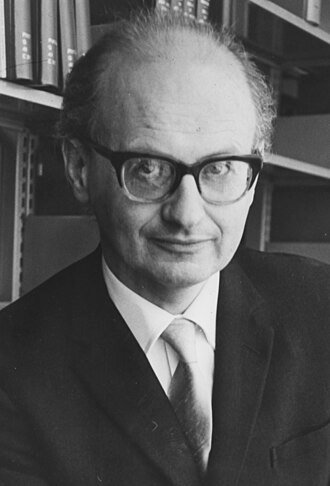
Imre Lakatos
1922–1974 · Hungarian philosopher and mathematician of science
Imre Lakatos (Debrecen, 1922 – London, 1974) was a Hungarian-born philosopher of mathematics and science, best known for his methodology of scientific research programmes and for his work on the philosophy of mathematics. Born Imre Lipsitz into a well-to-do Jewish family, he studied mathematics, physics and philosophy at the University of Debrecen. His career was shaped by the war, Hungarian communism and exile, and his thinking grew out of the tradition of Karl Popper, which he both followed and profoundly reshaped.
During the German occupation of Hungary he changed his surname to avoid antisemitic persecution; his mother and grandmother died at Auschwitz. After the war he worked in the Hungarian Ministry of Education and took a doctorate at Debrecen, but he was also involved in building the communist state. He was imprisoned in 1950 on charges of revisionism and, after his release, drifted away from the regime and joined dissident circles. Following the Soviet invasion of 1956 he fled to Vienna and later settled in England, where he earned a philosophy PhD at Cambridge in 1961 under R. B. Braithwaite. From 1960 he taught at the London School of Economics, where he joined the Popperian group and for years edited the British Journal for the Philosophy of Science.
His book Proofs and Refutations, drawn from his doctoral thesis, takes the form of a fictional classroom dialogue in which students try to prove Euler's formula for polyhedra. Each attempted proof is overturned by counterexamples, which Lakatos calls "monsters". Against the view that informal theorems are final, he argued that mathematical knowledge grows through a dialectic of conjectures, proofs and refutations, in which theorems are adjusted and their domains of validity extended.
In the philosophy of science he developed sophisticated falsificationism, a refinement of Popper. Theories are not discarded at the first anomaly; they are judged within research programmes. Each programme has a hard core protected by a belt of auxiliary hypotheses, and its progress is measured by its ability to predict novel facts. A programme is progressive when it achieves such predictions and degenerating when it only accommodates anomalies after the fact. The approach was also a response to Thomas Kuhn and his idea of paradigm shifts, and its influence now reaches the history of science and the social sciences.
Lakatos died suddenly of a heart attack in London in 1974, aged 51. His posthumous work Proofs and Refutations, and his correspondence with Paul Feyerabend, published as For and Against Method, made much of his thinking known, and it remains a subject of debate in the philosophy of science and of mathematics.
Key ideas
- Sophisticated falsificationism: theories are not abandoned at the first counterexample but compared within research programmes that may develop or degenerate.
- Scientific research programme: a sequence of related theories sharing a hard core, protected by a belt of adjustable auxiliary hypotheses.
- Positive and negative heuristics: the positive heuristic guides the programme's development, while the negative heuristic forbids refuting the hard core.
- Progressive versus degenerating programmes: a programme is progressive if it predicts new facts and degenerating if it merely accommodates anomalies after the fact.
- Fallibility of mathematics: informal mathematical knowledge grows through conjectures, proofs and refutations, and no theorem is final.
Works in Filopedia
Curiosities
A change of name, and then another
Lakatos changed his surname several times: first to Molnár during the Nazi occupation, and later to Lakatos, in honour of Géza Lakatos.
A book published after his death
Proofs and Refutations appeared after his death and is based on the first chapters of his Cambridge doctoral thesis.
Teachers and influences
Influenced by
- Paul Feyerabend 1924–1994
Influenced
- Paul Feyerabend 1924–1994
Original Filopedia text based on Wikipedia (es) and Wikipedia (en) and Wikidata.