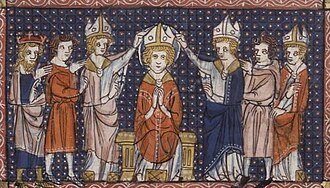
Hilary of Poitiers
315–367 · Bishop of Poitiers and Doctor of the Church
Hilary of Poitiers (c. 315-367) was a bishop, writer and one of the Fathers and Doctors of the Church, venerated as a saint. He lived in the fourth century, during the Arian controversy over the nature of the Son, and his firm defence of the Trinity earned him the titles ‘Hammer of the Arians’ and ‘the Athanasius of the West’. He matters because he was among the first to set out in Latin, with real rigour, the arguments about the Trinity that Greek theologians had developed.
He was born into a pagan, aristocratic family in Poitiers and received a fine education, with a strong command of Greek. He took an interest in philosophy, especially Neoplatonism, and reading the Scriptures led him to Christianity as an adult. He was baptised together with his wife and his daughter Abra, whom tradition venerates as a saint. Soon afterwards, the people acclaimed him as bishop of Poitiers.
His episcopate coincided with the rise of Arianism, which denied the full divinity of the Son. In 356 a synod at Béziers, summoned by the emperor Constantius II, banished him to Phrygia, a stronghold of Arianism. He spent almost four years there. The reasons remain unclear: the traditional explanation points to his refusal to condemn Athanasius, while some historians think opposition to the emperor on political grounds played a part. In exile he went on governing his diocese, deepened his knowledge of Greek and read Origen and the Eastern Fathers.
From this period came his major work, On the Trinity, in twelve books, which is often regarded as the first successful expression in Latin of the Trinitarian theology worked out in Greek. He also wrote On the Synods, a letter to the bishops of Gaul, Germany and Britain analysing the professions of faith of the Eastern bishops and urging Western bishops to be restrained in condemning them. His polemic against Constantius, whom he portrayed as a kind of Antichrist, belongs to the same years. His commentaries on Matthew and on the Psalms make up the exegetical side of his output.
After returning to Poitiers in 361 he fought Arianism among the local clergy. He became the patron of Martin, the future bishop of Tours, who founded a monastery at Ligugé. In 364 he travelled to Milan to denounce Auxentius, the city’s bishop, but the emperor Valentinian I heard the case and Auxentius gave satisfactory answers. Hilary died in Poitiers around 367 and was buried there beside his wife and daughter.
His thought centres on the Trinity: one God in three persons. The Father is eternal, invisible and incomprehensible, and no human language can exhaust him. The only-begotten Son shares the same substance as the Father, and his generation is not an event in time nor the same as a human child being born. To defend this he read the prologue of John’s Gospel word by word. His hymns, rediscovered in modern times, show him as a pioneer of Latin Christian poetry, ahead of Ambrose of Milan. His influence reached the formal definition of doctrine: Pius IX declared him a Doctor of the Church in 1851.
Key ideas
- The Trinity: one God existing in three persons, with the Father and the Son sharing the same divine substance.
- The incomprehensibility of God: no human language, however eloquent, can fully describe God.
- The eternal generation of the Son: the Son is not born at a moment in time or a second god, but the eternal Word united to the Father.
- Doctrinal moderation: many differences between Eastern formulas and orthodoxy were, in his view, more matters of words than of ideas.
- Religious poetry: his hymns brought to Latin Christianity a genre modelled on classical forms and the Psalms.
Curiosities
A name with meaning
His name comes from the Latin word for happy or cheerful. Hilary became a combative defender of orthodoxy.
Rediscovered hymns
His hymns were rediscovered in modern times, which allowed scholars to recognise him as a pioneer of Latin religious poetry.
Teachers and influences
Influenced
- Gilbert de La Porrée 1070–1154
Original Filopedia text based on Wikipedia (es) and Wikipedia (en) and Wikidata.