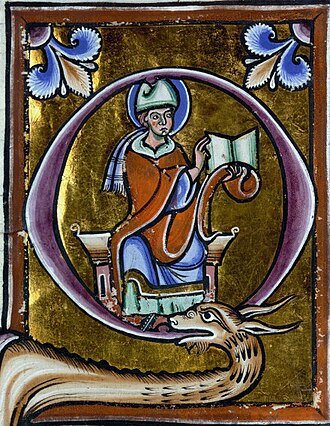
Gilbert de La Porrée
1070–1154 · Scholastic logician and theologian, Bishop of Poitiers
Gilbert de la Porrée, also known as Gilbert of Poitiers, was a scholastic logician and theologian of the twelfth century who also served as Bishop of Poitiers. He is remembered above all for his analysis of Aristotle's categories and for the controversy his views on the Trinity provoked.
He was born in Poitiers, probably around 1070, although some sources place his birth somewhat later. He studied under Bernard of Chartres and Anselm of Laon, taught at Chartres and then in Paris, and in 1142 was elected bishop of his native city. His most influential logical treatise, the De sex principiis, separates the properties of objects into inherent forms and subordinate, relational ones. In his commentary on Boethius's De Trinitate he distinguished pure being, God in himself, from the three persons of the Trinity, a distinction that clashed with church teaching. In 1148 a council at Reims condemned four of his propositions. Gilbert submitted quietly, accepted them, and kept a cordial relationship with his opponents until his death in 1154.
His reach was considerable. He is almost the only twelfth-century logician cited regularly by the great scholastics that followed, his work was commented on by Albertus Magnus, and Dante names him the Magister sex principiorum.
Key ideas
- Inherent and subordinate forms: of Aristotle's ten categories, only substance, quantity, quality and relation belong strictly to objects; the other six are relative and subordinate.
- Pure being and God: pure being, prior to everything that exists, corresponds to God in himself, incomprehensible to human categories.
- Forms, ideas and time: forms or ideas subsist without being substances; things are temporal, ideas are perpetual and God is eternal.
- One form, three persons: the divine form is one, while the persons who participate in it are three; this distinction lay at the heart of his condemnation.
Curiosities
A growing audience
The Cistercian Everard writes that he was the fourth to attend Gilbert's lectures in Chartres and the three hundredth to attend in Paris.
Classroom methods
John of Salisbury, who was his student, recounts that he would whip a student who made a grammatical error and suggest that anyone wasting time take up bread making.
Teachers and influences
Pupils
- John of Salisbury 1110–1180
- Alain of Lille 1114–1203
Influenced by
- Hilary of Poitiers 315–367
Original Filopedia text based on Wikipedia (es) and Wikipedia (en) and Wikidata.