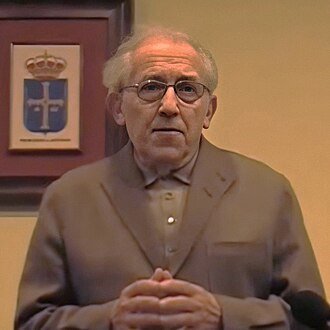
Gustavo Bueno
1924–2016 · Spanish philosopher, founder of philosophical materialism
Gustavo Bueno Martínez (Santo Domingo de la Calzada, 1924 – Niembro, Asturias, 2016) was a Spanish philosopher who, from the early 1970s, built a system of thought he called philosophical materialism. His work, closely engaged with the positive sciences and the history of philosophy, made him one of the most debated figures in contemporary Hispanic thought.
He studied in Zaragoza and Madrid, earned his doctorate in 1947 with a thesis on the modern philosophy of religion, and began teaching at a secondary school in Salamanca. His youth was tied to the Falange, a background that shaped his early years. In 1960 he settled in Oviedo, where he held a chair until 1998 and from where he later directed the Gustavo Bueno Foundation.
His most elaborate contribution is the theory of categorial closure, which explains how scientific knowledge is constituted. He also wrote on ontology, political philosophy, the history of ideas and the nature of the Spanish nation, in books such as Ensayos materialistas, El mito de la izquierda and España frente a Europa. His influence appears in doctoral theses, in the journals El Basilisco and El Catoblepas, and in translations into German, English and Chinese, although critics note uneven rigour in his writings on politics and ethics.
Key ideas
- Philosophical materialism. A doctrine opposed both to monistic materialism and to spiritualism, defending a rationalist pluralism in which matter is not reduced to the corporeal.
- Categorial closure. The view that each science constitutes its own field of relations, without being reducible to the others.
- Symploké. The principle that not everything influences everything, yet nothing is entirely isolated from everything else.
- Political nation. The modern idea of the nation, which emerged in the struggle against the Ancien Régime and is not equivalent to an ethnic identity.
Curiosities
Favourite son and adopted son
Santo Domingo de la Calzada named him its favourite son in 1997, and Oviedo, where he spent much of his career, made him an adopted son in 1995.
A scholastic memory
From a young age he showed a deep interest in theology, to the point that he was said to know scholastic philosophy by heart.
Original Filopedia text based on Wikipedia (es) and Wikipedia (en) and Wikidata.