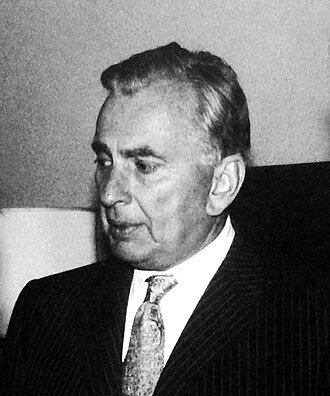
Gore Vidal
1925–2012 · American novelist, essayist and screenwriter
Gore Vidal (West Point, New York, 1925 - Los Angeles, 2012) was an American novelist, essayist, playwright and screenwriter, and one of the most recognizable public intellectuals of the second half of the twentieth century. He wrote in English, and his importance lies as much in his novels as in his sharp criticism of political power, sexuality and the social conventions of his country.
He was born at the cadet hospital of the United States Military Academy at West Point, where his father, an Army officer, taught aeronautics. He came from a family of the political elite: his maternal grandfather, Thomas P. Gore, was a Democratic senator from Oklahoma. Vidal spent part of his youth in Washington, where he read aloud to the senator, who was blind, and acted as his guide. He studied at St. Albans and Phillips Exeter Academy and, instead of going to university, enlisted in the Army at seventeen. He served in the Aleutian Islands, and after three years he suffered hypothermia and rheumatoid arthritis, which led to a desk-bound post.
His first novel, Williwaw, drawn from that military experience, was well received by critics. With The City and the Pillar (1948), which treated male homosexuality directly, he provoked considerable controversy; he later recalled that a critic at The New York Times stopped reviewing his books. In the early 1950s he wrote mystery novels under the pseudonym Edgar Box, while working in theatre, film and television. Plays such as The Best Man and the television work Visit to a Small Planet found success on Broadway and later on screen. He also worked as a screenwriter in Hollywood, although on Ben-Hur the official credit ultimately went to Karl Tunberg.
In the 1960s he settled in Italy. His fiction combines historical novels, such as Julian (1964) and the later Burr and Lincoln, with satire, such as Myra Breckinridge (1968), a comedy about gender identity that brought him notoriety. His essays on politics, history and literature are, for many readers, the most solid part of his work, and in 1993 he won the National Book Award for United States: Essays 1952-1992. He also ran unsuccessfully for office as a Democratic candidate in 1960 and 1982.
His legacy rests on his biting wit, his defence of sexual freedom and his incisive critique of power. Although he would have preferred to be remembered mainly as a novelist, many now regard him chiefly as a major essayist and an influential public figure.
Key works
- The City and the Pillar (1948): an early and widely read American novel that presents male homosexuality without moral condemnation.
- Julian (1964): a historical novel about the Roman emperor who tried to restore polytheism against Christianity.
- Myra Breckinridge (1968): a satire on gender identity and social roles that brought him wide notoriety.
- Burr (1973): a historical novel about Aaron Burr, the politician who killed Alexander Hamilton in a duel, and the politics of the young nation.
- Lincoln (1984): a novel about Abraham Lincoln and the public and private life of the president.
Works in Filopedia
- Myra Breckinridge 1968
Curiosities
A changed name
His birth certificate read Eugene Louis Vidal. At fourteen he dropped his first two names, and the surname Gore had been added at his christening in 1939.
A script without shared credit
He worked on the Ben-Hur screenplay with Christopher Fry, but the screenwriters' guild ultimately credited Karl Tunberg as the sole writer.
A blind grandfather
He read aloud to his grandfather, Senator Thomas P. Gore, who was blind, and guided him, which gave him access to Washington's political world at a very young age.
Teachers and influences
Influenced
- William Kennedy b. 1928
Original Filopedia text based on Wikipedia (es) and Wikipedia (en) and Wikidata.