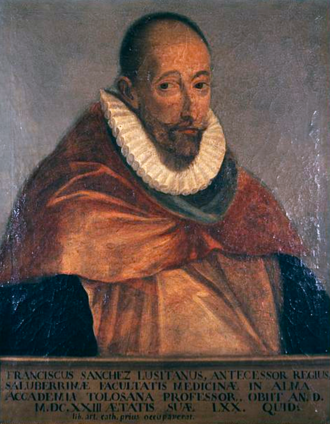
Francisco Sanches
1550–1623 · Hispano-Portuguese skeptic philosopher and Renaissance physician
Francisco Sanches, known as "the Skeptic", was a Renaissance philosopher and physician whose work was read mainly by scholars and doctors. He belongs to the skeptical tradition and is often seen as a forerunner of the methodical doubt later associated with René Descartes. His nationality has long been debated: he was probably born in Tui or in Braga, the son of a Spanish father and a Portuguese mother.
Around the age of eleven or twelve, his father, a physician of converso background who feared the Inquisition, moved the family to Bordeaux. There Sanches studied at the Collège de Guyenne, and later in Rome, Montpellier and Toulouse. He qualified in medicine at Montpellier in 1573 and soon won a chair there, which he held for years before settling in Toulouse, where he practised medicine and taught.
His best-known work, Quod nihil scitur, published in 1581, argues that science in the Aristotelian sense, knowledge of the necessary causes of nature, cannot be reached: the search for causes falls into an endless regress, and syllogisms add nothing new. We can know only appearances and phenomena, through experience and judgment. Even so, he held that this limited certainty was worth pursuing with method. The idea of a constructive scepticism later influenced Mersenne, Gassendi and the Royal Society.
Key ideas
- Against authority: nothing should be accepted merely because Aristotle or tradition says so; it must be examined directly.
- Limits of knowledge: we cannot grasp the essences of things, only their accidents and appearances.
- Constructive scepticism: that nothing is known absolutely does not prevent us from gaining limited knowledge through experience and judgment.
- Criticism of the syllogism: demonstration by syllogism is circular and does not extend our knowledge.
Original Filopedia text based on Wikipedia (es) and Wikipedia (en) and Wikidata.