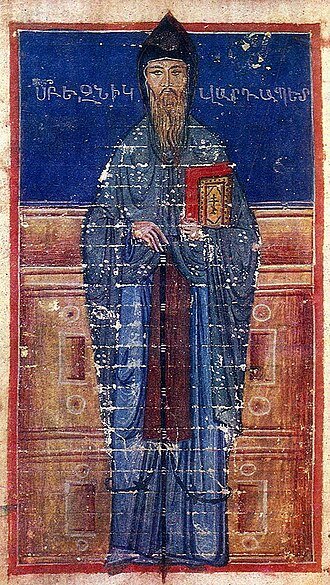
Eznik of Kolb
380–450 · Armenian theologian and translator of the 5th century
Eznik of Kolb was an Armenian Christian theologian, writer and translator of the first half of the fifth century. He is regarded as one of the major authors of the golden age of Armenian literature and as one of the first translators of the Bible into Armenian. His main work, usually called Refutation of the Sects or On God, is an apologetic treatise defending Christian belief against pagan, Persian and philosophical ideas.
He was born around 380 in Kolb, in the region of the Çoruh valley in what is now eastern Turkey. He was a pupil of Catholicos Sahak (Isaac) and Mesrop Mashtots, the creator of the Armenian alphabet. His teachers sent him to Edessa to study Syriac and then to Constantinople to improve his Greek and gather biblical manuscripts. On his return he helped revise the Armenian Bible against Greek texts. He may be the same Eznik who appears as bishop of Bagrevand at the Synod of Artashat in 449, though this is not certain.
The Refutation was written between roughly 441 and 449 in four parts. The first attacks the eternity of matter and the substantial existence of evil in pagan thought; the second refutes the main doctrines of Zoroastrianism; the third argues with the Greek philosophical schools, relying more on scripture than on reason; the fourth expounds and refutes Marcionism. The work shows wide learning and a polished style that is admired as a model of classical Armenian.
His reputation rests above all on the purity of his prose and his role in the early Armenian church. The original manuscript is lost; the text survives through a medieval copy dated 1280.
Key ideas
- Refutation of the Sects: an apologetic work defending Christian faith against paganism, Zoroastrianism, Greek philosophy and Marcionism.
- Criticism of the eternity of matter: he rejects the idea that matter is uncreated and holds that evil has no independent substance.
- Defence of free will: a central theme, locating the origin of evil in human will rather than in an independent principle.
- Use of Scripture: in his debate with the Greek philosophers he relies more on the Bible than on reason.
Original Filopedia text based on Wikipedia (es) and Wikipedia (en) and Wikidata.