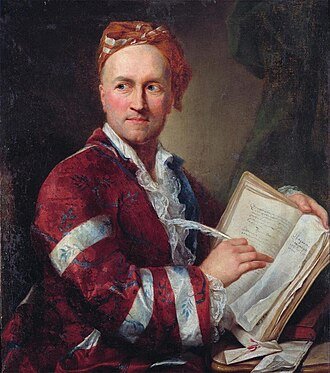
Emerich de Vattel
1714–1767 · Swiss philosopher, diplomat and jurist, a pioneer of international law
Emer de Vattel (1714-1767) was a philosopher, diplomat and jurist born in the Principality of Neuchâtel, now a Swiss canton. He was trained in the rationalist tradition of Leibniz and Christian Wolff, and he sought to bring those ideas to bear on law and relations between states. He is a key figure in the origins of modern international law.
The son of a Protestant minister, he studied in Basel and Geneva and in 1741 defended Leibniz's system against Jean-Pierre de Crousaz. He then entered the diplomatic service of Saxony. In 1746 the elector Augustus III gave him the title of councilor of embassy and sent him to Bern as his minister. His diplomatic work did not fill all his time, and he devoted the rest to literature and jurisprudence.
His principal work, The Law of Nations (1758), grew out of a Latin text by Wolff, which Vattel translated and expanded with his own thoughts. The book deals with the rights and obligations of citizens and states. From it comes his well-known "Golden Rule of Sovereigns": one cannot complain when treated as one treats others. In its day the work was regarded as a real handbook of diplomacy, and it had consequences for the theory of just war.
He wrote other works, among them Questions of Natural Rights (1762), which discussed Wolff's natural law philosophy. He worked so intensely that his health broke down, and he died in 1767 during a visit to Neuchâtel.
His influence was considerable, especially in North America, where his books were read by thinkers who shaped the American founders. Some of his precepts were later invoked to justify European expansion onto other people's lands, a reading now widely considered highly contestable.
Key ideas
- Law of nations: the body of rules governing relations between nations and sovereigns, grounded in natural law.
- Sovereignty of states: nations hold their own rights and should respect one another.
- Golden Rule of Sovereigns: no one can complain of treatment that he himself applies to others.
- Just war: the legitimacy of war depends on just causes and on rules that limit what states may do.
Curiosities
Copies for Franklin
Charles Dumas sent Benjamin Franklin three original French copies of the work. In 1775 Franklin wrote to him that the book had been continually in the hands of the members of the Congress.
A book returned 221 years late
A copy borrowed by George Washington in 1789 was never returned on time. In 2010 an identical copy was ceremonially returned to the library, which waived the unpaid late fees.
Original Filopedia text based on Wikipedia (es) and Wikipedia (en) and Wikidata.