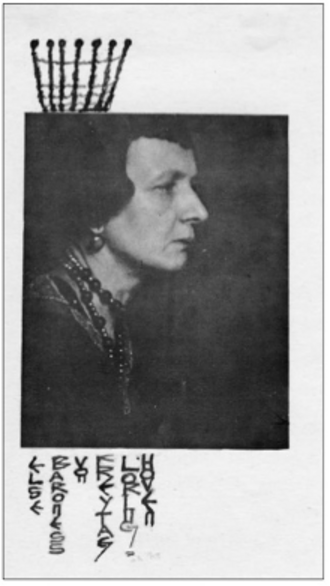
Elsa von Freytag-Loringhoven
1874–1927 · German artist and poet, a figure of Dada in New York
Elsa von Freytag-Loringhoven, born Elsa Plötz, was a German artist and poet who worked mainly in Greenwich Village, New York, between 1913 and 1923. She wrote poetry and made sculptures, assemblages and street performances, and her provocative life made her one of the first embodiments of Dada in the United States. She matters because she turned her own body and daily life into a central part of her art.
She was born in 1874 in Swinemünde, now Świnoujście in Poland, then part of the German Empire. After a childhood shaped by her father's strict control, she left home for Berlin at eighteen. She worked in cabarets and as an artist's model, and studied art in Dachau. Her first marriage, to the architect August Endell, was an open one; she later lived with the poet Felix Paul Greve and, in 1913, married the German baron Leopold von Freytag-Loringhoven in New York, taking his name.
In New York she posed for painters and moved in circles that included Djuna Barnes, Man Ray and Marcel Duchamp. She made sculptures and assemblages from street debris and appeared in public wearing costumes of spoons, tin cans and other rubbish, in performances that challenged ideas of femininity. Her short, phonetic poems began appearing in The Little Review in 1918, alongside chapters of Joyce's Ulysses, yet most of her writing stayed unpublished until 2011.
She returned to Berlin in 1923, penniless and in poor health, and died in Paris in 1927 from gas inhalation, in unclear circumstances. Her work stayed in obscurity for decades. Today she is studied as a forerunner of performance art and as an early voice on the body, gender and consumerism.
Key works
- Body Sweats: The Uncensored Writings of Elsa von Freytag-Loringhoven (2011), a posthumous collection of her writings and poems
- Enduring Ornament (1913), an assemblage made from found objects
- Cathedral (c. 1918), an assemblage of discarded materials
- Limbswish (c. 1920), one of the few surviving works from her New York years
Works in Filopedia
Curiosities
A possible role in Fountain
A letter from Marcel Duchamp to his sister mentions a female friend who sent in a urinal under a male pseudonym. Some researchers have proposed that she was the friend, though other experts have rejected this claim.
A funeral that was hard to find
Her funeral took place about two weeks after her death, in the cheapest section of Père Lachaise Cemetery. According to accounts, Djuna Barnes and other friends could not find the spot and ended up drinking at a bar.
Dada in the first person
The Little Review described her as the only living person in the world who dresses Dada, loves Dada and lives Dada.
Original Filopedia text based on Wikipedia (es) and Wikipedia (en) and Wikidata.