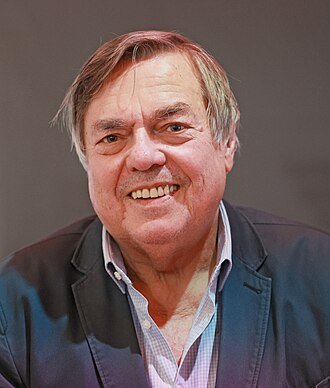
Drago Jančar
b. 1948 · Slovenian novelist, playwright and essayist
Drago Jančar (born in Maribor, 1948) is one of the best-known Slovene writers of his generation. A novelist, playwright, poet and essayist, he writes in Slovene, and his work matters because it turns specific episodes of Central European history into studies of the human condition. His public commentary has also made him a figure in Slovenia's political debates.
He studied law in his native Maribor. As a student he edited the journal Katedra, but critical articles brought him into conflict with the communist authorities and he had to leave the post. He then worked at the daily Večer. In 1974 he was arrested for bringing into Yugoslavia a booklet about the killings of Slovene Home Guard prisoners at Kočevski Rog, and was sentenced for spreading hostile propaganda. For years he was barred from publishing. After the deaths of Kardelj and Tito in the late 1970s, things loosened, and he worked as a screenwriter and playwright. By the mid-1980s he had won recognition at home, and by the end of the decade his work was reaching readers in Central Europe, Spain and Italy.
His prose is laconic and ironic, often with tragicomic turns. His novels usually start from real events in Central European history and examine the clash between individuals and repressive institutions such as prisons, galleys, asylums and barracks. As an essayist he took clear positions at key moments. During the war in Bosnia he backed the Bosnian cause, and in his essay Short Report from a City Long Besieged he questioned the uncertain role of intellectuals in ethnic and political conflict. In the 1990s he also clashed with the Austrian writer Peter Handke over the breakup of Yugoslavia.
His legacy lies at the point where literature meets public debate. He is regarded as one of the major figures of recent Slovene fiction, and his friendship with the writer Boris Pahor, a survivor of the Nazi camps, shaped much of his moral view of literature.
Key works
- Thirty-Five Degrees (1974), a novel about repression in the Yugoslavia of its day.
- Katarina, the Peacock and the Jesuit (2000), a novel about history and faith in a setting of conflict.
- I Saw Her That Night (2010), a novel that confirmed his international reputation.
- Ringing in the Head (1998), a novel about memory and the weight of history.
- The Broken Jug (1992), an essay on the craft of writing and the role of the intellectual.
Teachers and influences
Influenced by
- Boris Pahor 1913–2022
Original Filopedia text based on Wikipedia (es) and Wikipedia (en) and Wikidata.