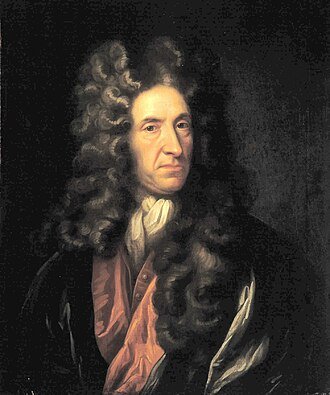
Daniel Defoe
1660–1731 · English novelist, journalist and pamphleteer
Origins and early years
Daniel Foe, later known as Daniel Defoe, was born in London, probably in Fore Street in the parish of St Giles Cripplegate, in the autumn of 1660, although sources give dates between 1659 and 1662. His father, James Foe, was a tallow chandler of probable Flemish descent and a member of the Worshipful Company of Butchers. His mother, Alice, died when he was about ten. Later he added the aristocratic-sounding "De" to his name and occasionally claimed descent from a family called De Beau Faux, a claim that does not hold up.
The family were Presbyterian dissenters, meaning their beliefs did not fully match those of the Church of England, which was the established church and supported by the state. This had practical consequences, since dissenters in England faced civil and academic restrictions. Defoe lived through major events as a child: in 1665 the Great Plague killed tens of thousands in London, and the following year the Great Fire left only a handful of houses standing in his neighbourhood. In 1667 a Dutch fleet sailed up the Medway and attacked Chatham.
Education
Defoe was first sent to a school in Dorking run by the Reverend James Fisher, and then, at around fourteen, to the dissenting academy of Charles Morton at Newington Green, then a village just north of London. Morton's academy offered a broader curriculum than the universities, with scientific and practical subjects, and it shaped the young writer. When he finished, Defoe decided he did not want to become a minister, though his thinking kept a strong moral and religious base.
Business, debt and marriage
He entered commerce as a general merchant, trading at different times in hosiery, woollen goods and wine. His ambitions were considerable: he bought a country estate and a ship, and even dabbled in civets, whose musk was used to make perfume. Yet he was rarely free of debt, and his debts led him to prison more than once.
On 1 January 1684 he married Mary Tuffley, the daughter of a London merchant, who brought a dowry of £3,700. Debts and political troubles strained the marriage, but it lasted forty-seven years and produced eight children, six of whom survived. In 1685 Defoe joined the ill-fated rebellion of the Duke of Monmouth against James II, but he obtained a pardon that spared him from the repression led by Judge George Jeffreys.
In 1692 he was jailed for debts of around £700 and, faced with total liabilities that may have reached £17,000, was forced into bankruptcy. After his release he probably travelled in Europe and Scotland, and it may have been then that he traded wine with Cádiz, Porto and Lisbon. By about 1695 he was back in England, now formally using the name Defoe and working as a commissioner of the glass duty, collecting taxes on bottles; in 1696 he ran a tile and brick factory at Tilbury in Essex.
Pamphleteer, politician and prisoner
The most famous part of his public life began with his pen. His first notable work was An Essay upon Projects (1697), a set of proposals for social and economic improvement. He defended King William III's right to keep a standing army during disarmament, and his most successful poem, The True-Born Englishman (1701), answered xenophobic attacks on the Dutch-born king. That same year he presented to Parliament a memorial in support of the Kentish petitioners, who asked for backing for a war against France.
The death of William III in 1702 changed the scene, and Queen Anne launched a campaign against the Nonconformists. In December 1702 Defoe published The Shortest-Way with the Dissenters, an ironic pamphlet which, pretending to propose their extermination, savagely satirised the high church Tories and the dissenters who practised hypocritical conformity. Once the author was identified, he was convicted of seditious libel at the Old Bailey, fined 200 marks, and sentenced to stand in the pillory, which he did on 31 July 1703. Legend says the crowd threw flowers instead of the usual rubbish and drank to his health when he read his Hymn to the Pillory; most historians doubt the story, though it has remained a popular anecdote.
After three days in the pillory he was taken to Newgate Prison, an experience he later drew on in Moll Flanders. Robert Harley, 1st Earl of Oxford, arranged his release in exchange for Defoe's services as an intelligence agent, and paid some of his debts, which greatly eased his finances. About a week after leaving prison, Defoe lived through the Great Storm of November 1703, which caused severe damage in London and Bristol and which he described in The Storm, often regarded as one of the first examples of modern journalism.
In 1704 he launched A Review of the Affairs of France, which backed Harley's government and followed the War of the Spanish Succession until 1713, appearing almost without interruption. When Harley fell in 1708, Defoe wrote in support of Godolphin, and then returned to working for Harley and the Tories from 1710 to 1714. When Queen Anne died and the Tories fell, Defoe continued doing intelligence work for the Whig government, even writing pamphlets that undermined the Tory position.
The mission to Scotland and the Union of 1707
One of the best documented episodes of his life is his role in the Union between England and Scotland, which was completed by the Act of 1707. In September 1706 Harley sent him to Edinburgh as a secret agent to win Scottish opinion for the treaty. From there he wrote that "a Scots rabble is the worst of its kind", since his early reports described violent demonstrations against the Union. As a Presbyterian he was accepted as an adviser to the General Assembly of the Church of Scotland and attended committees of the Scottish Parliament, which allowed him to influence the proposals being debated.
His method was to tailor his message to each audience: in England he defended the Union as an end to the northern threat and a commercial advantage, while in Scotland he argued the opposite of what he said in the south, stressing the treaty's guarantees. Some of his pamphlets were presented as the work of Scots, a deception that misled reputable historians. In 1709 he published a lengthy history of the Union, which some specialists still cite, though he always kept the last word for himself.
He received little reward from his paymasters and no official recognition. Years later, in his Tour thro' the Whole Island of Great Britain (1724–1727), he admitted that the growth of trade and population in Scotland he had predicted as a result of the Union had not happened, quite the reverse.
The years of the novel
Defoe wrote his first great novel when he was nearly sixty. Robinson Crusoe appeared in 1719 and tells of a sailor shipwrecked on a desert island for twenty-eight years and his later adventures. It was probably based in part on the real case of the Scottish sailor Alexander Selkirk, rescued in 1709 after four years on the Juan Fernández Islands. Before 1719 was out it had already reached four editions, and it became one of the most widely published books in history, giving its name to the whole genre of the robinsonade. Its hero combines adventure with spiritual development: Crusoe argues with God in his crises and only reaches a more sincere conversion after years of solitude.
There followed works of great variety: Captain Singleton (1720), about travels in Africa and piracy; Memoirs of a Cavalier (1720), set during the Thirty Years' War and the English Civil War; A Journal of the Plague Year (1722), an account of the Great Plague of 1665 narrated in the first person by a man who was barely five years old when it happened; Colonel Jack (1722), about an orphan who moves from poverty and crime to prosperity. That same year he published Moll Flanders, a picaresque novel narrated by a woman who passes as a prostitute, bigamist and thief yet keeps the reader's sympathy, and Roxana (1724), about the moral decline of a courtesan who never has a true conversion.
In his last years he also wrote conduct manuals, such as The Family Instructor (1715), and essays on social order and the supernatural, such as The Political History of the Devil (1726), which some contemporaries took as a joke and which critics now read as a sincere expression of his providentialist outlook. His most documentary work was A Tour thro' the Whole Island of Great Britain, a panoramic survey of British trade on the eve of the Industrial Revolution.
Style, reception and legacy
Defoe wrote in a plain, direct and sober prose, closely attentive to material detail. His narrators often pose as witnesses or editors of the stories they tell, a strategy of verisimilitude that has fuelled long debate over whether his works are fiction or documentary. Many of his books were published anonymously or under pseudonyms, which makes attribution difficult: some five hundred titles have at various times been credited to him, though most specialists accept with confidence only about seventy-five.
His work is considered one of the first landmarks of the English novel, and his name is placed alongside Aphra Behn and Samuel Richardson in the history of the form. He is also remembered as a pioneering journalist and as a precursor of the economic press. He died on 24 April 1731, probably in hiding from his creditors in London, and was buried in Bunhill Fields. A monument to his memory was erected in 1870, and a street in the Bronx, New York, bears his name.
Key works
- Robinson Crusoe (1719): a castaway survives for years on a desert island, the origin of a whole subgenre.
- Moll Flanders (1722): a fictional memoir of a woman who gets by on deceit in London, reflecting the city's underworld.
- A Journal of the Plague Year (1722): a reconstruction of the 1665 plague in London, often read as if it were an eyewitness account.
- Roxana: The Fortunate Mistress (1724): the story of a courtesan who rises socially and pays a heavy price for her choices.
Where to start
Robinson Crusoe 1719
Robinson Crusoe is the most accessible starting point for Defoe: a story of shipwreck and survival on an island, told with practical detail and great ingenuity. The reader will find adventure, reflections on work, faith and solitude, and the origins of the modern English novel.
Next: A Journal of the Plague Year. A Journal of the Plague Year shows another side of Defoe, more sober and documentary, and displays his talent for giving fiction the appearance of real testimony.
Works in Filopedia
Books to read
- The Life and Adventures of Robinson Crusoe EnglishEPUB 319 KBRead online
- The Fortunes and Misfortunes of the Famous Moll Flanders EnglishEPUB 338 KBRead online
- The Fortunate Mistress (Parts 1 and 2) or a History of the Life of Mademoiselle de Beleau Known by the Name of the Lady Roxana EnglishEPUB 406 KBRead online
- Robinson Crusoe EnglishEPUB 431 KBRead online
- The Life and Most Surprising Adventures of Robinson Crusoe, of York, Mariner (1801) EnglishEPUB 335 KBRead online
- The History of the Pyrates. Vol. II. Containing the lives of Captain Misson, Captain Bowen, Captain Kidd, Captain Tew, Captain Halsey, Captain White, Captain Condent, Captain Bellamy, Captain Fly, Captain Howard, Captain Lewis, Captain Cornelius, Captain Williams, Captain Burgess, Captain North, and their several crews EnglishEPUB 386 KBRead online
- The Further Adventures of Robinson Crusoe EnglishEPUB 265 KBRead online
- The Life and Adventures of Robinson Crusoe (1808) EnglishEPUB 557 KBRead online
- The Complete English Tradesman (1839 ed.) EnglishEPUB 337 KBRead online
- The History of the Devil, As Well Ancient as Modern: In Two Parts EnglishEPUB 378 KBRead online
- The Storm or, a Collection of the most Remarkable Casualties and Disasters which Happen'd in the Late Dreadful Tempest, both by Sea and Land EnglishEPUB 229 KBRead online
- The True-Born Englishman: A Satire EnglishEPUB 98 KBRead online
- An Essay Upon Projects EnglishEPUB 152 KBRead online
- Voyages et Aventures Surprenantes de Robinson Crusoé FrenchEPUB 83 KBRead online
- The Life, Adventures & Piracies of the Famous Captain Singleton EnglishEPUB 297 KBRead online
Curiosities
A storm up close
Within a week of leaving prison, Defoe witnessed the Great Storm of 1703, which battered London and Bristol and killed more than 8,000 people, mostly at sea.
Flowers at the pillory
According to legend, the crowd at his pillory punishment threw flowers instead of rubbish and drank to his health. Most scholars doubt that the story is true.
A genre named after a book
*Robinson Crusoe* was imitated so often that its title now names a whole genre, the Robinsonade.
Teachers and influences
Influenced
- Charles Dickens 1812–1870
- Jules Verne 1828–1905
- Virginia Woolf 1882–1941
Original Filopedia text based on Wikipedia (es) and Wikipedia (en) and Wikidata.