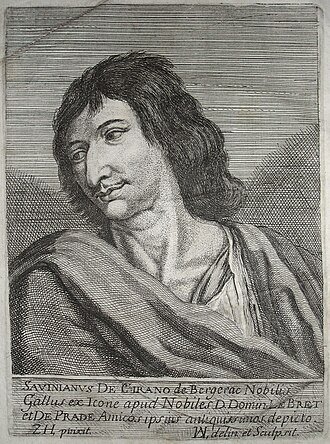
Cyrano de Bergerac
1619–1655 · French 17th-century poet, playwright and satirist, libertine thinker and precursor of science fiction
Hercule-Savinien de Cyrano de Bergerac (Paris, 1619 – Sannois, 1655) was a French poet, playwright, satirist and thinker of the seventeenth century. He belonged to the libertine current, a circle of writers who questioned the religious and political authority of their time and defended free thought and, to a large extent, a materialist view of nature. Today he is remembered mainly as a precursor of science fiction, although his popular fame comes from a play written long after his death.
He was born in Paris into a family of magistrates and merchants who had risen socially. He spent much of his childhood in Saint-Forget before studying at the Beauvais college, where his teacher Jean Grangier later became the target of a caricature in his comedy The Pedant Tricked. In 1638 he took the name Bergerac, from lands bought by his grandfather, which helped the family enter the minor nobility. He joined the Company of the Guards and became known for his bravery and his many duels. He left the army in 1641, after taking part in the sieges of Mouzon and Arras, and then began to frequent libertine circles and to study philosophy with Pierre Gassendi, a priest who tried to reconcile Epicurean atomism with Christianity.
His finances were soon exhausted by a disorderly life, and in 1653 he left Paris. In those years he entered a satirical quarrel with the writer Charles Coypeau d'Assoucy, against whom he wrote a pamphlet titled Contre Soucidas, an anagram of his rival's name. He also wrote political pamphlets during the Fronde, first against Mazarin and later in his service. His tragedy La Mort d'Agrippine, staged in 1653, shocked audiences with its open atheism and failed on the stage. His most ambitious work, L'Autre Monde, remained unpublished during his lifetime. In it the narrator travels to the Moon and the Sun, and from that fantasy he sets out his materialism and criticises the beliefs and customs of his age. His friend Henry Le Bret published it after editing it: the voyage to the Moon appeared in 1657 and the one to the Sun in 1662. He died in Sannois in 1655, aged thirty-six, after an injury traditionally attributed to a falling beam; some historians suspect an attack, though the matter is unresolved.
His central ideas revolve around satire aimed at authority, the defence of reason against dogma, and a materialist view of nature. His imaginary journeys allowed him to show, by contrast, how arbitrary human customs are, and to present a universe governed by natural causes. His influence was considerable: his novels anticipated themes later taken up by writers such as Swift, Poe and Voltaire, and Molière borrowed ideas from his comedy, though he alone was accused of plagiarism. After Edmond Rostand's play of 1897 his figure became a character of popular literature, largely idealised, with an image of a shy and brilliant lover that the documented record hardly supports.
Key ideas
- Libertine satire: criticism of religious and political authority as a way of thinking freely.
- Materialism: the explanation of the world through natural causes, without appeal to divine intervention.
- Satirical science fiction: the journey to the Moon and the Sun as a pretext for examining one's own customs and beliefs.
- Atomism and reason: the legacy of Gassendi, who defended the rational inquiry of nature.
Books to read
- L'autre monde; ou, Histoire comique des Etats et Empires de la Lune FrenchEPUB 196 KBRead online
- A Voyage to the Moon EnglishGutenberg
Curiosities
A name taken from land
In 1638 he adopted the name Bergerac, taken from lands his grandfather had bought after growing rich from a fishmonger's business.
An anagram as a weapon
His satire against Coypeau d'Assoucy was titled Contre Soucidas, an anagram of his rival's name.
Original Filopedia text based on Wikipedia (es) and Wikipedia (en) and Wikidata.