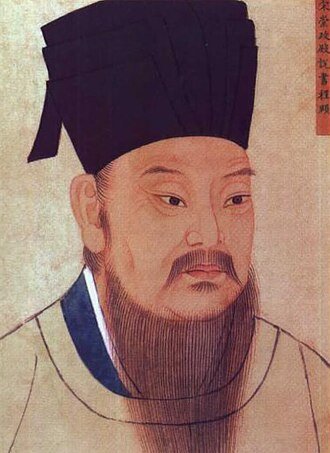
Cheng Yi
1033–1107 · Chinese Neo-Confucian philosopher of the Song dynasty
Cheng Yi (1033–1107) was a Chinese philosopher, classicist and politician of the Song dynasty and one of the central figures of Neo-Confucianism. Together with his older brother Cheng Hao, he is associated with Zhu Xi in the Cheng–Zhu school, also called the Rationalistic School. He studied under Zhou Dunyi, was a friend of Shao Yong and a nephew of Zhang Zai, and Zhu Xi counted the five of them, along with Sima Guang, among the Six Great Masters.
Born in Luoyang, in Henan, in 1033, he entered the national university in 1056 and received the scholar's degree in 1059. He lived and taught in Luoyang, declining many high offices. He opposed the reforms of Wang Anshi and, once the reformers had been removed, was appointed expositor-in-waiting in 1086, which allowed him to lecture the emperor on Confucianism. More forceful and unyielding than his brother, he made several enemies, among them Su Shi, leader of the Sichuan group. In 1097 his rivals managed to ban his teachings, confiscate his property and exile him. He was pardoned three years later, but was blacklisted and his work was banned again in 1103. He received a final pardon in 1106, a year before his death.
His thought distinguishes the rational pattern inherent in each thing, which can be understood through patient study, from the passions that obscure it. He held that studying the classics and reflecting on the principles of things lead to moral wisdom. His influence was considerable: in 1452 his descendants and other Confucian sages were granted the title Wujing Boshi. He is widely credited with the growth of the cult of widow chastity, although some scholars note that he directed this mainly at the scholar-official class rather than at peasants. His ideas shaped later Neo-Confucianism and Chinese philosophy through the Ming and Qing periods.
Key ideas
- Principle (li): the ordering rational pattern underlying all things, which humans can come to understand.
- Investigation of things: patient, gradual study of the classics and of the world as the way to grasp that principle.
- Nature and passions: human nature is fundamentally good, though passions can obscure it and it must be cultivated.
- Moral seriousness: virtue is reached through personal earnestness and fidelity to principle rather than through emotion.
Curiosities
Waiting in the snow
Two men, Yang Shi and You Zuo, asked to become his disciples and waited for hours in the snow at his door. The episode gave rise to the chengyu 立雪門, used to praise devotion to learning.
A controversial saying
He reportedly stated that starving to death is a small matter, while losing one's chastity is a great one. The phrase became a symbol of the moral debate over widows.
Original Filopedia text based on Wikipedia (es) and Wikipedia (en) and Wikidata.