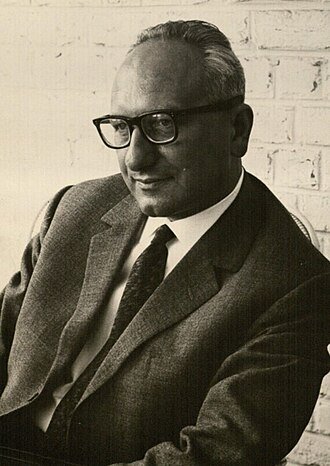
Chaïm Perelman
1912–1984 · Belgian philosopher, rhetorician and argumentation theorist of Polish origin
Chaïm Perelman (Warsaw, 1912 – Brussels, 1984) was a philosopher, logician and legal theorist of Polish origin who spent his career in Belgium. He is one of the central figures of twentieth-century argumentation theory, thanks to the so-called new rhetoric, which revived ancient rhetorical tradition as a basis for non-formal reasoning.
His family moved to Antwerp in 1925. After studying law and earning a doctorate in 1934, he took a second doctorate in 1938 with a dissertation on Gottlob Frege. That same year he was appointed at the Université Libre de Bruxelles, where he stayed for most of his life. He began within logical positivism, but an empirical study of justice, completed in 1944, led him to conclude that value judgments could not be subjected to logical rigour, forcing him to rethink the rational foundations of philosophy, law and ethics.
From 1948 he worked with Lucie Olbrechts-Tyteca. Their joint work, The New Rhetoric (1958), argues that argument aims at winning the adherence of an audience, whether particular or universal. Perelman defended a regressive philosophy built on probabilities and social truths. After his period in Pennsylvania from 1962, his ideas reached the English-speaking world and left a lasting mark on rhetoric, informal logic and legal philosophy.
Key ideas
- Value judgment: legal and practical decisions rest on valuations that formal logic cannot fully prove.
- Universal audience: the speaker addresses an ideal audience of reasonable people, not only those present.
- Regressive philosophy: philosophical truths should be built on probabilities and be open to change as audiences and experience shift.
- New rhetoric: non-formal argument is studied through its techniques and the adherence it secures from its audience.
Original Filopedia text based on Wikipedia (es) and Wikipedia (en) and Wikidata.