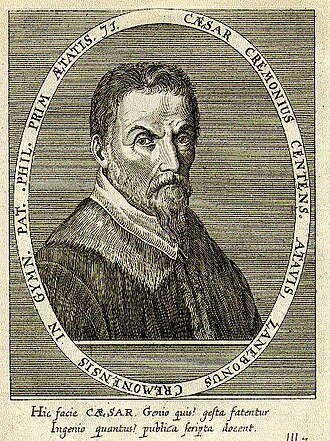
Cesare Cremonini
1550–1631 · Italian Aristotelian philosopher, professor of natural philosophy at Ferrara and Padua
Cesare Cremonini (Cento, 1550 – Padua, 1631) was an Italian philosopher of the late sixteenth and early seventeenth centuries and one of the most influential figures of the Paduan school. Trained in the Aristotelian tradition, he taught natural philosophy for more than fifty years, first at Ferrara, where he enjoyed the patronage of Duke Alfonso II d'Este, and then at the University of Padua, which he held from 1591 until his death.
His reputation was considerable. He corresponded with kings and princes, and at Padua he was paid twice what Galileo earned. He read Aristotle through Alexander of Aphrodisias and Averroes, and argued that reason alone cannot prove the immortality of the soul; faithful to the Stagirite, he regarded the soul as mortal. This view, together with his remarks about the Jesuits and lay teachers, earned him charges of materialism and atheism, and in 1604 the Inquisition ordered him to retract. Cremonini declined, hiding behind Aristotle's authority, and Venetian tolerance kept the matter from going to full trial.
His motto, "Intus ut libet, foris ut moris est", captured a double stance: think privately as you wish, and in public follow custom. His main works, including treatises on the soul, the heavens and innate heat, appeared mainly from 1596 onward. His influence spread chiefly through his students, among them William Harvey and Gabriel Naudé, and his name came to stand for European free thought.
Key ideas
- Mortality of the soul: natural reason cannot show that the soul survives the body, and a strict Aristotelianism points to its mortality.
- Fidelity to Aristotle: his method is to expound the Stagirite's doctrines and to defend him against Galen when they disagree.
- Double truth as conduct: to think one thing as a philosopher and publicly observe what religious custom demands.
- Aristotelian cosmology: he upheld the perfection of the lunar sphere and the distinct nature of celestial substance, which led him to refuse Galileo's telescopic evidence.
Curiosities
Refusal to look through the telescope
When Galileo announced mountains on the Moon, he offered Cremonini the chance to see them through his telescope, but Cremonini refused and insisted that Aristotle had proved the Moon could only be a perfect sphere.
A double salary
At Padua he was paid twice what Galileo earned, a sign of the esteem in which he was held as a teacher.
Teachers and influences
Pupils
- Joachim Jungius 1587–1657
Original Filopedia text based on Wikipedia (es) and Wikipedia (en) and Wikidata.