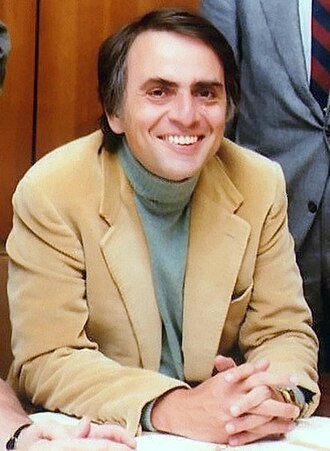
Carl Edward Sagan (New York, 1934 – Seattle, 1996) was an American astronomer, planetary scientist and science communicator who wrote in English and made the study of the planets and the cosmos a public conversation. He taught at Harvard and, above all, at Cornell, where he directed the Laboratory for Planetary Studies. What makes him matter is that he combined research at the frontier of planetary science with an unusual gift for explaining it to readers and viewers without specialist training.
Born in Brooklyn to a family of Ukrainian Jews with Reform leanings, Sagan grew up in a household shaped by contrasting temperaments. His father worked in the garment trade, and his mother, who had known extreme poverty as a girl, encouraged his intellectual ambitions. Both parents, he later argued, taught him the uneasy pairing of skepticism and wonder that he saw at the heart of science. The Great Depression and the war in Europe touched his childhood mainly through family worry. He sought answers about the stars at the public library, and science fiction gave him a taste for imagining life on other worlds. The 1939 New York World's Fair left him with images that resurfaced in his later work.
He earned his doctorate in astronomy and astrophysics at the University of Chicago in 1960. After a fellowship at Berkeley, he worked with the team behind the Mariner 2 probe and published a 1961 paper in Science on the atmosphere of Venus. His observations of that planet helped make him one of the first scientists to study the greenhouse effect at planetary scale. His research ranged from exobiology to the search for extraterrestrial intelligence through SETI, and he took part in NASA programs including Mariner, Viking and Voyager.
His popular writing matched the scale of his research. He wrote many technical papers and more than twenty books for general readers, in a style built on clear analogies, a strong sense of the universe's scale and a personal voice. He promoted sending messages aboard the Pioneer and Voyager spacecraft, intended in principle for any intelligence that might find them. He was also a champion of skepticism and critical thinking, a theme at the heart of The Demon-Haunted World.
The 1980 documentary series Cosmos: A Personal Voyage made him known far beyond academic circles. As narrator and co-writer, he presented the history of science and the cosmos to an audience estimated at hundreds of millions across dozens of countries. The companion book became a major bestseller. His novel Contact, published in 1985, was adapted as a film in 1997, and in 1978 he won the Pulitzer Prize for General Nonfiction for The Dragons of Eden.
His legacy runs across several areas. For many later science communicators he remains a reference point for explaining science without oversimplifying it. His former students, among them Neil deGrasse Tyson and Bill Nye, have carried that work forward on television and in classrooms. His papers, running to hundreds of thousands of documents, are held by the Library of Congress, and his name remains linked to the idea that curiosity about the universe is a shared human culture.
Key works
- Contact (1985): a science fiction novel about the first signal received from another civilization, adapted as a film in 1997.
- Cosmos (1980): the companion book to the documentary series, tracing the history of humanity's knowledge of the universe.
- The Demon-Haunted World (1995): an essay on scientific thinking and the defense of skepticism against superstition.
- The Dragons of Eden (1977): a study of the evolution of human intelligence, awarded the Pulitzer Prize.
- Pale Blue Dot (1994): a reflection on Earth seen from a distance, inspired by the photograph taken by Voyager 1.
Curiosities
A library and a star
He recalled that as a child he asked a librarian for a book about stars and, after a first wrong answer, found one explaining that stars were suns very far away.
A time capsule
The 1939 World's Fair left a lasting impression, and as an adult he and his colleagues designed messages meant to travel through space, such as the Pioneer plaque.
Teachers and influences
Pupils
- Neil deGrasse Tyson b. 1958
Influenced
- Neil deGrasse Tyson b. 1958
Original Filopedia text based on Wikipedia (es) and Wikipedia (en) and Wikidata.