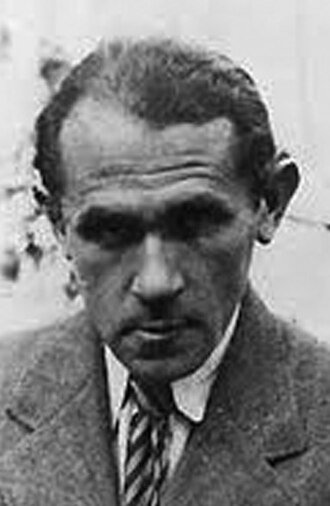
Bruno Schulz (born 1892 in Drohobycz, now Drohobych in Ukraine; died there in 1942) was a Polish-Jewish writer, but also a painter, draughtsman and literary critic. He is widely regarded as one of the great prose stylists in Polish literature of the twentieth century. He lived in a town that passed through several hands, from the Austro-Hungarian Empire to Nazi occupation, and his work grew out of that unstable setting.
He came from an assimilated Jewish family: his father ran a cloth shop, and at home people spoke only Polish, with no Jewish religious practice. After finishing school he began studying architecture in Lwów, but illness forced him to break off his studies. He recovered, went back to the course, and briefly studied in Vienna during the First World War, though he never completed a degree. When Drohobycz became part of the reborn Second Polish Republic, he returned home and taught drawing and crafts at a secondary school for almost two decades. By most accounts he saw the job mainly as a source of income, and he would keep his pupils entertained by telling them stories during lessons.
His fiction grew largely out of letters he wrote to his friend Debora Vogel, in which he described his solitary life and the lives of his family and neighbours with striking originality. The novelist Zofia Nałkowska read them and urged him to publish them as stories. The result was The Cinnamon Shops in 1934, known in English as The Street of Crocodiles, followed three years later by Sanatorium Under the Sign of the Hourglass. His prose mixes the everyday with the dreamlike: a father, a house and a small town turn into a mythic world governed by metamorphosis. He rarely mentioned the historical events of his time.
In 1938 he received the Golden Laurel of the Polish Academy of Literature. After the German and Soviet invasion of 1939, Drohobycz came under Soviet and then German control. He was reportedly working on a novel called The Messiah, which was lost along with several stories from the early 1940s. In the ghetto, a Gestapo officer, Felix Landau, protected him in exchange for murals painted in his residence. In November 1942, while walking home with a loaf of bread, he was shot dead by another Gestapo officer, Karl Günther, in a killing linked to a personal feud with Landau.
His reputation rests largely on critics and researchers such as Artur Sandauer and Jerzy Ficowski, who gathered manuscripts, drawings and testimonies after the war. Today he is one of the most translated Polish authors, and his work has inspired films, stage productions and scholarship across many countries.
Key works
- The Street of Crocodiles (1934)
- Sanatorium Under the Sign of the Hourglass (1937)
- The Trial (Polish translation of Kafka, 1936)
Curiosities
A cinnamon shop
According to the sources, his book *The Cinnamon Shops* takes its title from one of its stories, and in English it is known as *The Street of Crocodiles*, a name drawn from one of its chapters.
A rediscovered mural
The mural he painted for Felix Landau was covered over and forgotten after the war, and was rediscovered in 2001.
Teachers and influences
Influenced
- China Miéville b. 1972
Original Filopedia text based on Wikipedia (es) and Wikipedia (en) and Wikidata.