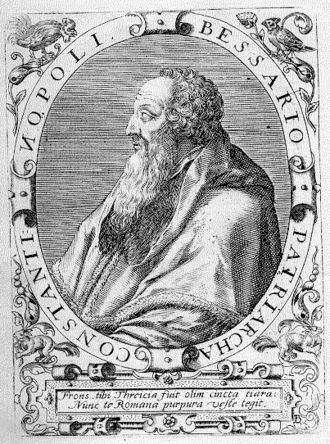
Basilios Bessarion
1403–1472 · Byzantine scholar, cardinal and defender of Platonism
Bessarion (Trebizond, 1403 – Ravenna, 1472) was a Byzantine Greek churchman and scholar who became a cardinal of the Catholic Church. He belongs to the Greek humanism of the Renaissance and matters because he built bridges between the Byzantine and Latin worlds, and between Platonism and Christian Aristotelianism. The year of his birth varies across sources, which give 1389, 1395 or 1403.
He was educated in Constantinople and in 1423 travelled to Mystras, in the Peloponnese, to study under Gemistus Pletho. That same year he entered the Basilian order and took the monastic name Bessarion. He was ordained a priest in 1431 and soon afterwards was made archbishop of Nicaea by Emperor John VIII Palaeologus. He accompanied the emperor to Italy in an attempt to reunite the Eastern and Western churches at the councils of Ferrara and Florence, where he became one of the most prominent advocates of union. Pope Eugene IV made him a cardinal in 1439, and from then on he lived mostly in Italy.
His most famous work is In Calumniatorem Platonis, written in defence of Plato against George of Trebizond, an Aristotelian who had attacked him. Bessarion respected Aristotle, whom he also translated, but believed the two philosophies could be reconciled. His Neoplatonic training stayed with him throughout his life and led him to open Platonism to religious questions.
As a cardinal he became a patron of humanists and Greek exiles, and he gathered a large library of Greek and Latin manuscripts, which he gave to the Republic of Venice in 1468, forming the basis of the Biblioteca Marciana. He came close to being elected pope in 1455, though his Greek origins counted against him. In 1463 he received the largely ceremonial title of Latin Patriarch of Constantinople. In 1472 he was sent to France to promote a crusade against the Ottomans, and he died on the return journey at Ravenna.
His legacy is best understood as a bridge between East and West, and between philosophical traditions, helping to spread Greek learning among Italian humanists.
Key ideas
- Harmony of Plato and Aristotle: he held that the two philosophies were not incompatible and sought to reconcile them.
- Christian Neoplatonism: he applied Platonism to theological questions, widening the religious speculation of his age.
- Union of the churches: he argued at the councils of Ferrara and Florence that the Orthodox and Catholic churches could be reconciled.
- Greek humanism: he promoted the translation and preservation of Greek texts for the Latin world.
Curiosities
A library that still survives
He gave his collection of Greek and Latin manuscripts to Venice in 1468. It forms the core of the Biblioteca Marciana.
Almost pope
At the 1455 conclave he was short of election by just two votes, and his Orthodox origins worked against him.
A lunar crater
The lunar crater Bessarion is named in his memory.
Teachers and influences
Teachers
- Gemistus Pletho 1355–1452
Original Filopedia text based on Wikipedia (es) and Wikipedia (en) and Wikidata.