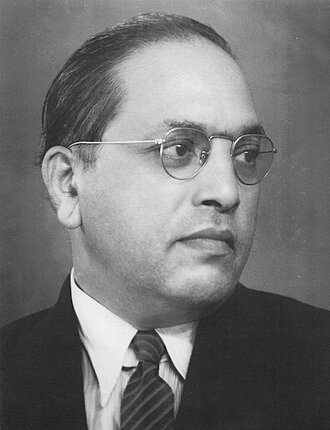
B. R. Ambedkar
1891–1956 · Indian jurist, economist and social reformer who fought for the rights of Dalits
Childhood and origins
Bhimrao Ramji Ambedkar was born on 14 April 1891 in Mhow, a town and military cantonment in central India (now officially Dr Ambedkar Nagar, in Madhya Pradesh). He was the fourteenth and last child of Ramji Maloji Sakpal, an officer of the British Indian Army who held the rank of subedar, and of Bhimabai Sakpal. The family came from the Marathi town of Ambadawe, in Ratnagiri district, in what is now Maharashtra, and his ancestors had for generations served the British East India Company's army. Ambedkar belonged to the Mahar caste, regarded as untouchable and subjected to strict socio-economic discrimination.
School and segregation
Untouchable children attended school, but they were segregated and received little attention from teachers. They were not allowed to sit inside the classroom, and when they needed water, someone of a higher caste had to pour it from a height, since they could touch neither the water nor the vessel holding it. Ambedkar later summed up this humiliation in the phrase "No peon, No Water", because if the school's peon was absent, the boy simply went without drinking. He was also required to sit on a gunny sack, which he had to carry home. After his father retired in 1894, the family moved to Satara, and Ambedkar's mother died shortly afterwards; the children were looked after by a paternal aunt in hard circumstances. His original surname was Sakpal, but his father registered him at school as Ambadawekar. A Brahmin teacher, Krishnaji Keshav Ambedkar, changed the name in the school records to his own surname, Ambedkar.
Mumbai and early studies
In 1897 the family settled in Mumbai, where Ambedkar became the only untouchable student enrolled at Elphinstone High School. In 1906, at about fifteen, he married Ramabai, a girl of nine, in an arranged match made by the families according to the custom of the time. He passed the matriculation examination in 1907 and entered Elphinstone College, affiliated with the University of Bombay, the following year; by his own account, he was the first man of his Mahar caste to do so. His community held a public ceremony to celebrate the achievement, and on that occasion Dada Keluskar, an author and family friend, gave him a biography of the Buddha, a reading that would shape his later interest in Buddhism.
Studies abroad
In 1912 he obtained his degree in economics and political science from the University of Bombay and was preparing to take up work with the government of the princely state of Baroda when, in 1913, he had to hurry back to Bombay to see his ailing father, who died on 2 February of that year. That same year he won a scholarship from the Maharaja of Baroda, Sayajirao Gaekwad III, to study at Columbia University in New York, where he came under the influence of John Dewey and the philosophy of pragmatism. He completed his master's degree in 1915 with the thesis Ancient Indian Commerce, and in 1916 presented a second thesis, National Dividend of India, as well as the paper Castes in India: Their Mechanism, Genesis and Development. In parallel he enrolled at Gray's Inn in London to train as a barrister and at the London School of Economics, where he began a doctoral thesis. He had to return to India in 1917 when his scholarship ended, and in 1920 he went back to London with support from Shahu of Kolhapur. He received his LSE degree in 1921 and a doctorate in economics in 1923, and was called to the bar.
Early career and first campaigns
Back in India Ambedkar struggled to make a living: the Baroda army dismissed him once it discovered he was an untouchable, his attempts at tutoring and financial consulting failed, and in 1918 he became professor of political economy at Sydenham College in Mumbai, where other faculty objected to sharing water with him. In 1920 he launched the weekly Mooknayak with the help of Shahu of Kolhapur, and in 1924 he founded the Bahishkrit Hitakarini Sabha to promote education and social advancement for the so-called depressed classes. As a lawyer he successfully defended three non-Brahmin leaders against a libel suit in 1926. In 1927 he led a protest at Mahad to secure the right of untouchables to draw water from the town's public tank, and in December that year he publicly burned copies of the Manusmriti, which he condemned as an ideological justification for caste discrimination; 25 December is still observed by his followers as Manusmriti Dahan Din. In 1930 he led the movement for entry to the Kalaram Temple in Nashik.
The Poona Pact and political life
In 1932 the British government's Communal Award granted separate electorates to the depressed classes. Gandhi opposed this with a fast in Yerwada Central Jail in Poona, and on 24 September 1932 the Poona Pact was signed, reserving seats for the depressed classes within the general electorate and giving them 148 legislative seats instead of the 71 proposed in the award. That same year Ambedkar announced his intention to leave Hinduism. In 1935 he became principal of the Government Law College in Bombay, and in 1936 he founded the Independent Labour Party, which contested the 1937 elections. That year he published Annihilation of Caste, a sharp critique of the caste system and of orthodox Hindu leaders that included a rebuke of Gandhi. In 1940 and 1941 he published his writings on the partition of India, arguing that forcing Hindus and Muslims into a single state would produce continuing conflict.
The Constitution and the ministry
When India became independent in 1947, Jawaharlal Nehru made him Law Minister, and within a few weeks he was appointed chairman of the drafting committee of the Constitution. The Constitution, adopted on 26 November 1949, guaranteed a wide range of civil liberties, abolished untouchability and introduced a system of reserved places in jobs and education for scheduled castes and tribes and other backward classes. In 1951 he resigned from the government after the failure in Parliament of the Hindu Code Bill, which he had championed to strengthen women's rights. He stood unsuccessfully in the 1952 and 1954 elections and later sat in the Rajya Sabha as a nominated member. His first wife, Ramabai, had died in 1935; in 1948 he married Savita Kabir, a doctor, who took the name Savita Ambedkar.
Conversion to Buddhism and final years
Ambedkar considered converting to Sikhism but, after talks with Sikh leaders, concluded that he would be accorded second-rate status. Around 1950 he turned seriously to Buddhism, attended meetings of the World Fellowship of Buddhists in Ceylon and Burma, and founded the Bharatiya Bauddha Mahasabha in 1955. His last book, The Buddha and His Dhamma, was completed in 1956, and he asked Nehru unsuccessfully for government support to promote it. On 14 October 1956, in Nagpur, he and his wife formally took the Three Refuges and Five Precepts from a Buddhist monk, and he then converted around half a million of his followers. He died in his sleep on 6 December 1956 in Delhi, a few days after finishing that book. His Buddhist cremation at Dadar Chowpatty beach in Mumbai drew half a million mourners.
Legacy and reception
After his death his stature was affirmed in Indian public life: in 1990 the government awarded him the Bharat Ratna, the country's highest civilian honour, and many institutions bear his name, including the airport at Nagpur, Ambedkar University Delhi and the National Institute of Technology in Jalandhar. In 2012 a poll by History TV18 and CNN-IBN chose him as the greatest Indian since independence, ahead of Patel and Nehru. Economists such as Narendra Jadhav and Amartya Sen have highlighted his contributions to economic thought, particularly on finance, currency and agrarian reform. His conversion to Buddhism revived interest in Buddhist philosophy in India and abroad and inspired mass conversion ceremonies. His work has also drawn criticism, both for a one-sided emphasis on caste and for neglecting organisation-building. Statues in his honour in Hyderabad, Vijayawada, and the planned monument at Indu Mill in Mumbai testify to a public memory that continues to grow.
Key ideas
- Critique of caste: the caste system is a structure of hierarchy and exclusion built by society, not a natural order.
- Political and social equality: the untouchables need political rights, education and legal guarantees, not charity alone.
- Democratic liberalism: individual freedom and constitutional democracy form the necessary framework for emancipation.
- Buddhism as an alternative: Buddhism offers a moral path without caste hierarchy, which is why he adopted it as a religious and political response.
Where to start
Aniquilation of Caste is a speech Ambedkar wrote in 1936 for an anti-caste conference in Lahore, which was never delivered in its intended form. In it he lays out, plainly and without detours, his critique of the caste system and of the religion that sustains it, along with his ideas on social reform. It is a direct and accessible reading for grasping the core of his thought.
Next: Castes in India: Their Mechanism, Genesis and Development. Caste in India: Its Mechanism, Genesis and Development expands the analysis with an anthropological view of the origin and structure of castes, complementing the political critique with historical and academic grounding.
Works in Filopedia
Books to read
- The Problem of the Rupee, Its Origin and Its Solution EnglishGutenberg
Curiosities
«No peon, No Water»
At school, a peon had to pour water for the young Ambedkar from a height. If he was unavailable, the boy went without water. Later he described the situation in his writings with that phrase.
A biography of the Buddha
At a public ceremony held by his community to celebrate his academic success, Dada Keluskar, an author and family friend, gave him a biography of the Buddha.
Sunken books
His book collection was sent on a different ship from the one carrying him, and that vessel was torpedoed and sunk by a German submarine in 1917.
Teachers and influences
Teachers
- John Dewey 1859–1952
Influenced by
- The Buddha 500 BC–500 BC
- John Dewey 1859–1952
- Kabir 1398–1518
Original Filopedia text based on Wikipedia (es) and Wikipedia (en) and Wikidata.