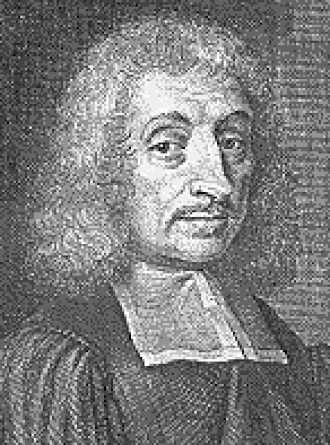
Arnold Geulincx
1624–1669 · Flemish rationalist and occasionalist philosopher
Arnold Geulincx (Antwerp, 1624 – Leiden, 1669) was a Flemish philosopher, metaphysician and logician who belonged to the circle of followers of Descartes. He tried to develop a more detailed version of the Cartesian system, and he is remembered today for his occasionalism and for his idea of a pre-established harmony, which Leibniz would later make far more famous. His ideas also reached modern readers through Samuel Beckett, who valued Geulincx's stress on human powerlessness and ignorance.
He studied philosophy and theology at the University of Leuven, where he became professor of philosophy in 1646. He lost this post in 1658, possibly for religious reasons, or perhaps because of unpopular views combined with his marriage that same year. In September 1658 he qualified as a medical doctor, and he then moved north to the University of Leiden, where he converted to Calvinism. At first he taught privately; in 1662 he was named reader in logic, and in 1665 professor by special appointment. He died in Leiden in November 1669, probably of an epidemic, at about forty-five. Most of his work, written in Latin, remained unpublished until after his death, when Cornelis Bontekoe edited it.
Geulincx condensed his thought into the phrase «Ita est, ergo ita sit»: it is so, therefore it is so. To escape the Cartesian split between mind and body, he proposed that the two are coordinated by a harmony fixed in advance. Unlike Leibniz, he did not link this harmony to the optimism of the best of all possible worlds. For him, the human being does not truly act: the will provokes our deeds, but these are only occasional causes, and God is the real cause. The central virtue is therefore humility, and wisdom lies in willing only what lies within our power. His theory of knowledge is modest, reaching only the surface of things and our own actions.
Key ideas
- Pre-established harmony: mind and body are coordinated by an order set by God in advance, without one directly causing the other.
- Occasionalism: our actions are only occasions; the true cause of movements and sensations is God.
- You do not do what you do not know how is done: the human being is a spectator of his own actions, which he never fully understands.
- Humility: the basic virtue is recognising that we are not the cause of what we do.
- Superficial knowledge: we can know only our own actions and passions; true wisdom belongs to God.
Curiosities
An aphorism Beckett liked to repeat
Samuel Beckett often repeated his aphorism «Where you are worth nothing, there you should want nothing» to overly inquisitive critics. Geulincx also appears in Beckett's novel Molloy, where the narrator recalls his figure with affection.
Teachers and influences
Pupils
- Ehrenfried Walther von Tschirnhaus 1651–1708
Original Filopedia text based on Wikipedia (es) and Wikipedia (en) and Wikidata.