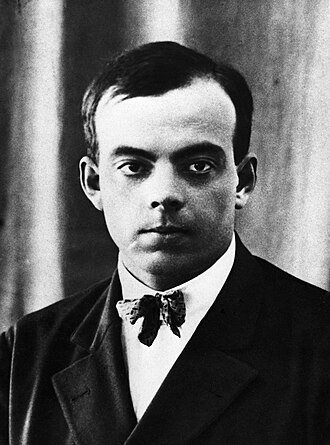
Antoine de Saint-Exupéry
1900–1944 · French aviator, writer and journalist
Childhood and family
Antoine Marie Jean-Baptiste Roger, Viscount of Saint-Exupéry, was born in Lyon on 29 June 1900 into an old Catholic aristocratic family. His surname recalls the 5th-century bishop Saint Exuperius. He was the third of five children of Jean de Saint-Exupéry and Marie Boyer de Fonscolombe. His father died of a stroke at the La Foux railway station when the future writer was not yet four, and the loss deeply altered the family's finances, leaving them as impoverished aristocrats. His mother, who had worked as a nurse, raised the children in an almost entirely female household of aunts, sisters and servants.
Education and early setbacks
His younger brother François, to whom he was deeply attached, died of rheumatic fever at fifteen while both were students at the Marianist college Villa Saint-Jean in Fribourg, Switzerland, during the First World War. Saint-Exupéry sat at his bedside, and the scene left him with an image he later reworked for the ending of The Little Prince. At seventeen, with his father and brother gone, he became the only man in the household and took on the role of protector of his mother and sisters. He finished secondary school in 1917. He twice failed the final examinations of the preparatory course for the Naval Academy, then spent about fifteen months as an unregistered auditor at the École des Beaux-Arts studying architecture, without graduating. In the years that followed he drifted through odd jobs.
Military service and flying
In 1921 he began his military service as a private in the 2nd Mounted Hunters Regiment, stationed at Neuhof near Strasbourg. There he took private flying lessons and the following year transferred from the army to the air force. He earned his pilot's wings after being posted to the 37th Fighter Regiment in Casablanca, then moved to the 34th Aviation Regiment at Le Bourget, outside Paris, where he had the first of his many crashes. Under pressure from the family of his fiancée, the future novelist Louise de Vilmorin, he left flying for an office job, but the engagement ended and he spent several years in varied work before returning to the cockpit in 1926 as a civil pilot.
Commercial aviation and the desert
He joined Latécoère, later Aéropostale, and took part in the early international airmail flights, when aircraft carried few instruments and routes crossed largely unknown terrain. He flew between Toulouse and Dakar and in 1927 was posted as station manager at Cape Juby in the Sahara, then under Spanish administration. His duties included negotiating the release of downed pilots held by Saharan tribes, a dangerous task that earned him the Légion d'honneur in 1930. In 1929 he moved to Argentina to direct Aeroposta Argentina, the company's South American subsidiary. Based in Buenos Aires, he mapped new routes across the continent, negotiated agreements and flew mail and search missions for missing airmen. There he met Consuelo Suncín, a Salvadoran writer and artist, and they married in Grasse in 1931. The marriage was turbulent: he travelled constantly and had many affairs, most notably with the Frenchwoman Hélène de Vogüé, and Consuelo was for him both muse and a constant source of anguish.
Flying books and engagement
His first novel, Southern Mail, appeared in 1929, and Night Flight in 1931 brought him fame and the Prix Femina. Both draw on his years as a mail pilot. From 1932 he devoted himself mainly to journalism and writing, reporting on Indochina in 1934, on Moscow in 1935 and on Spain at the start of the Civil War in 1936 and 1937. In December 1935 he crashed in the Libyan Desert while attempting a record flight from Paris to Saigon. With his mechanic, André Prévot, he survived four days without water, subsisting on a few grapes, two oranges and some wine, until a Bedouin found them. That ordeal inspired Wind, Sand and Stars (1939), which won the Grand Prix du roman of the Académie française and, in its English edition, the U.S. National Book Award. Its meditations on human dignity and solidarity run throughout the book.
War and exile
When the Second World War broke out he was called up to a reconnaissance squadron and flew dangerous missions until France's armistice in June 1940. After demobilisation he travelled through Portugal and reached New York at the end of 1940, hoping to persuade the United States to join the war against Nazi Germany. There he published Flight to Arras, about the German invasion of France, and Letter to a Hostage, addressed to the French living under occupation. During his exile he wrote The Little Prince, which he drafted and illustrated with his own watercolours in 1942 as a children's tale with a critical eye on the adult world. It appeared in English and French in the United States in 1943. Because his books were banned under the Vichy regime, the French edition only came out in 1946, after his death. It became the book that made him known worldwide.
Final years and disappearance
Despite being far past the age limit for combat pilots and suffering lasting effects from his crashes, Saint-Exupéry managed in 1943 to return to active service with the Allied forces in North Africa, assigned to a photographic reconnaissance unit flying P-38 Lightnings. After an accident on his second mission he was grounded for months, then reinstated through General Ira Eaker. His relations with the French authorities were strained: General Charles de Gaulle publicly implied that he supported Germany, and the writer fell into deep depression and heavier drinking. On 31 July 1944 he took off from Corsica on a reconnaissance mission over the Rhône valley ahead of the Allied landings in southern France, and he did not return. He was declared Mort pour la France.
Discovery and legacy
In 1998 a fisherman found a silver identity bracelet bearing his name near Riou Island, and in May 2000 a diver located wreckage of a P-38 in the sea off Marseille. The remains were recovered in 2003 and confirmed in 2004 as those of his aircraft. The cause of the crash remains unresolved: in 2008 the former German pilot Horst Rippert claimed to have shot him down, but his account could not be verified. Today he is commemorated in the Panthéon in Paris, in airports and schools, in museums devoted to his life, and above all in the book that made him universal. The Little Prince has been translated into more than two hundred languages and ranks among the best-selling books in history.
Key ideas
- Responsibility to others: people define themselves through the bonds and commitments they take on.
- Humanism and solidarity: shared risk and work reveal what connects people across borders.
- Critique of the adult outlook: in The Little Prince, a world of numbers and conventions blinds people to what really matters.
- Clear-eyed view of war: his work combines admiration for courage with a rejection of the absurdity of conflict.
Where to start
The Little Prince 1943
The Little Prince is a short, illustrated poetic tale that any reader can approach without prior training. It recounts a pilot's encounter in the desert with a little prince from another planet, and through their conversations the book reflects on friendship, love, and the way adults see the world.
Next: Wind, Sand and Stars. Wind, Sand and Stars gathers his memoirs as a pilot, with the same human and poetic outlook, and shows the real experience that inspired much of his work.
Works in Filopedia
- Southern Mail 1929
- Night Flight 1931
- Wind, Sand and Stars 1939
- Flight to Arras 1942
- The Little Prince 1943
Curiosities
Survival in the Sahara
In 1935, after a forced landing in the desert, he and his navigator were found by a Bedouin only on the fourth day, having suffered dehydration and hallucinations. The episode inspired passages in Wind, Sand and Stars.
A brother behind the story
The death of his younger brother François, at fifteen, left him with an image that reappeared at the end of The Little Prince, where a child's fall recalls that of a young tree.
First published in New York
The Little Prince appeared in New York in 1943, while the author was living in exile during the war. The French edition from Gallimard came out posthumously in 1946.
Original Filopedia text based on Wikipedia (es) and Wikipedia (en) and Wikidata.