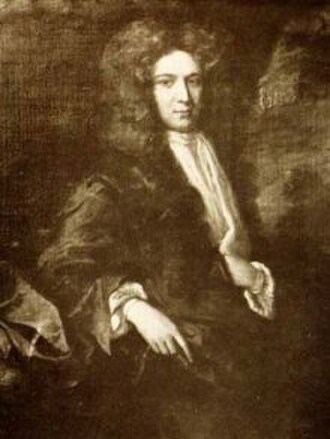
Anthony Collins
1676–1729 · English philosopher and essayist, deist and defender of necessitarianism
Anthony Collins (1676-1729) was an English philosopher and essayist, and one of the early advocates of Deism in Great Britain. He belonged to a generation of English freethinkers who, at the beginning of the eighteenth century, debated reason, revelation and established religion amid fierce controversy. His work matters because it gathered the objections of earlier English freethinkers and pushed them further.
He was born at Heston, near Hounslow in Middlesex, the son of a lawyer. He was educated at Eton and King's College, Cambridge, and studied law at the Middle Temple. His friendship with John Locke, whom his letters describe with warmth, was the most notable episode of his life. In 1715 he settled in Essex, where he served as a justice of the peace. He died at his house in Harley Street, London.
His first notable work was the Essay concerning the Use of Reason (1707), in which he rejected the distinction between what is above reason and what is contrary to it, and demanded that revelation conform to natural ideas of God. His chief work, A Discourse of Freethinking (1713), presented free inquiry as an inalienable right, necessary for reaching the truth and for the good of society, and argued that the Bible itself endorses it. The book stirred a great debate and drew several replies, including one from Richard Bentley. In 1724 he published a treatise on the grounds of the Christian religion that questioned whether Old Testament prophecies were literally fulfilled in Christ and denied the canonicity of the New Testament, provoking many answers. In philosophy he stood out as a defender of necessitarianism with his Inquiry Concerning Human Liberty (1717), which Samuel Clarke rebutted; Collins replied in 1729 with Liberty and Necessity.
Collins was also a great book collector, with one of the largest private libraries of his time. His influence can be seen in later debates over deism and biblical criticism, and his courteous style, in contrast with the harshness of his opponents, gave him a distinctive place in the history of freethought.
Key ideas
- Reason and revelation: revelation must conform to what reason can grasp about God, and there is no such thing as truths contrary to reason.
- Freedom of thought: free inquiry is a right and the only path to truth, and it contributes to the good of society.
- Necessitarianism: human actions are determined by causes, and freedom of the will must be understood within that framework.
- Criticism of prophecy: the fulfilment of prophecies in Christ's life is, in his view, secondary and allegorical, not a literal proof of Christianity.
Curiosities
An enormous library
Collins assembled one of the largest private libraries of his time, with some 6,906 books on all subjects.
Anonymous authorship
Like nearly all his works, it was published anonymously, although the authorship was never concealed for long.
Original Filopedia text based on Wikipedia (es) and Wikipedia (en) and Wikidata.