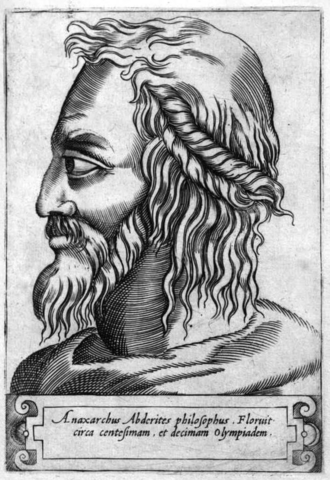
Anaxarchus
379 BC–319 BC · Greek atomist and early skeptic philosopher, friend of Alexander the Great
Anaxarchus of Abdera was a Greek philosopher of the late fourth century BC who belonged to the school of Democritus and is regarded as an early forerunner of Greek skepticism. Little of his writing survives, and most of what is known about him comes from anecdotes whose reliability is uncertain, which makes him a somewhat elusive figure.
He studied under Diogenes of Smyrna, who in turn had been a pupil of Metrodorus of Chios. He later joined the entourage of Alexander the Great on his campaigns in Asia and became a close companion of the king. His own pupil Pyrrho travelled with him, and Anaxarchus taught him to remain calm in the face of external circumstances. The sources portray his position at court in contradictory ways: some describe him as a flatterer, since he is said to have urged people to worship Alexander while he was still alive, while others show him mocking the king's claims to divinity. Several witty remarks are attributed to him, such as asking whether Alexander could hurl thunderbolts like Zeus, or a joke at a banquet in Tyre in 331 BC about fish (kephalos) and heads (kephale) of tyrants, which earned him the lasting hostility of Nicocreon of Cyprus.
His thought starts from the claim that human perception does not reliably match reality. Everything we perceive may be deceptive, much like a painted stage set, a dream or madness. From this he draws a practical kind of skepticism: since the world is uncertain, the only sensible aim is happiness, or eudaimonia, which requires cultivating adiaphora, a freedom from disturbance. Trying to separate truth from falsehood through the senses is both futile and harmful to peace of mind. Because we cannot know whether an action is good or bad, one should not chase the good for its own sake but seek happiness instead. In his work On Monarchs he argued that breadth of knowledge can be both helpful and harmful, and that the truly wise person knows what to say and when to say it.
According to tradition, his death was violent. After a shipwreck left him in Cyprus, he fell into the hands of Nicocreon, who had him pounded to death in a mortar. He is said to have endured the punishment while mocking his tormentors, and when threatened with the loss of his tongue, he bit it off and spat it at the tyrant. These stories made him a model of the wise man's self-mastery. His influence can be seen chiefly in Pyrrho and in later skepticism, which took up his notion of suspending judgement and his pursuit of tranquillity.
Key ideas
- Appearance and reality: what we perceive may be false and deceptive, like a painted scene or a dream.
- Practical skepticism: faced with uncertainty, it is wiser to give up fixing truth through the senses and to attend to what brings tranquillity.
- Eudaimonia and adiaphora: the aim of life is happiness, which requires indifference to disturbances.
- Happiness over the good: since we cannot know whether an action is good or bad, happiness rather than the good itself guides conduct.
- Knowledge and timing: the sage is not defined by accumulated learning but by knowing what to say and when to say it.
Curiosities
The question about thunder
According to the sources, when thunder sounded over the palace he asked Alexander whether he could hurl thunderbolts like Zeus. The king laughed and replied that he would refrain, so as not to frighten the courtiers.
The fall into the swamp
When Anaxarchus fell into a swamp, Pyrrho walked past without helping him. Far from being offended, Anaxarchus praised his pupil for following the impassivity he himself had taught him.
Teachers and influences
Teachers
- Metrodorus of Chios 500 BC–400 BC
Pupils
- Pyrrho 360 BC–270 BC
Original Filopedia text based on Wikipedia (es) and Wikipedia (en) and Wikidata.