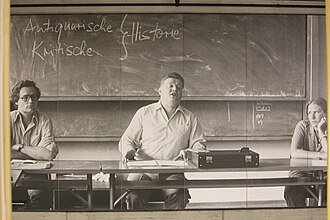
Alfred Schmidt
1931–2012 · German philosopher of the Frankfurt School's second generation
Alfred Schmidt (Berlin, 1931 – Frankfurt am Main, 2012) was a German philosopher associated with the second generation of the Frankfurt School. A student of Max Horkheimer and Theodor W. Adorno, he is best remembered for his work on Karl Marx, of which he became one of the most respected interpreters, and for his critical reading of the German philosophical tradition.
The son of a mechanic, he first studied classical and English literature at Goethe University in Frankfurt. After attending Horkheimer's lectures he turned to philosophy. His doctoral thesis on the concept of nature in Marx, published in 1962 as Der Begriff der Natur in der Lehre von Karl Marx, remains highly regarded. He obtained a chair at Goethe University in 1972, was made emeritus in 1999, and gave his last lecture in July 2012, shortly before his death.
His work centres on critical theory and on a reading of Marx that gives weight to nature and to human sensuousness. In History and Structure (1971) he examined and criticised Marxist structuralism, while Feuerbach, or the Emancipated Sensibility (1973) recovered Feuerbach's anthropological materialism. He also wrote on Goethe and on Schopenhauer's philosophy of religion, and he edited and studied Horkheimer, to whom he devoted a monograph on the idea of critical theory. His writings were translated into many languages, and for the French edition of his thesis he added a substantial preface on an ecological Marxism.
Schmidt is remembered as a rigorous interpreter of Marx and the Frankfurt School, and his work on nature and materialism remains a reference in debates about Marxism and ecology.
Key ideas
- The concept of nature in Marx: nature is not merely an external object but a constant mediation between human beings and the world they transform through labour.
- Critique of Marxist structuralism: reducing history to impersonal structures, he argued, overlooks human agency and concrete social contradictions.
- Feuerbach's anthropological materialism: sensibility and bodily experience are the basis of a real human emancipation.
- Critical theory as practical project: philosophy should analyse society in order to contribute to its transformation, in line with Horkheimer.
- Schopenhauer and religion: he examined Schopenhauer's philosophy of religion as a way of unmasking the illusions people use to console themselves.
Works in Filopedia
Original Filopedia text based on Wikipedia (es) and Wikipedia (en) and Wikidata.