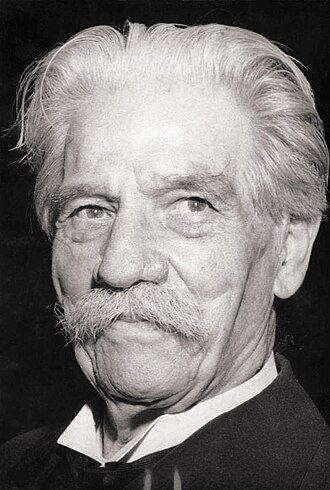
Albert Schweitzer
1875–1965 · Franco-German physician, theologian and philosopher, organist and musicologist
Childhood and education
Ludwig Philipp Albert Schweitzer was born on 14 January 1875 in Kaysersberg, in Alsace, then part of the German Empire. The son of Louis Théophile Schweitzer, a Lutheran-Evangelical pastor, and Adèle Schillinger, he grew up in Gunsbach, where his father taught him music. The medieval village church was shared by Protestant and Catholic congregations, who took turns during Sunday services, an arrangement that dated from the Reformation and the Thirty Years' War. This religious coexistence shaped his conviction that true Christianity should work towards a unity of faith and purpose. His first language was Alsatian German.
Studies and early musical training
In 1893 he finished secondary school in Mulhouse, where he had studied the organ with Eugène Munch, organist of the Protestant cathedral, who passed on his enthusiasm for Richard Wagner. That same year he played for the French organist Charles-Marie Widor at Saint-Sulpice in Paris. Widor was so impressed that he agreed to teach him without payment, and a lasting friendship began. Schweitzer studied theology at the Kaiser Wilhelm University in Strasbourg, took lessons in piano and counterpoint, and attended Wagner operas there; in 1896 he travelled to the Bayreuth Festival. In 1898 he returned to Paris to write a dissertation on Kant's religious philosophy and to study seriously with Widor, with whom he later prepared a new edition of Bach's organ works.
Theologian and critic of the historical Jesus
In 1899 he became a deacon at Saint Nicholas church in Strasbourg, and in 1900 he was ordained. That year he saw the Oberammergau Passion Play. His first major work, published in 1906 as The Quest of the Historical Jesus, surveyed the study of Jesus from Reimarus to Wrede. Schweitzer rejected both the liberal portrait of Jesus as a moral teacher and the traditional dogmatic view. He argued that Jesus believed the Kingdom of God was imminent, regarded himself as its messenger, and accepted the suffering he thought necessary to bring it about. This reading places him among the founders of
Key ideas
- Reverence for life: respect for every form of life is the highest ethical principle.
- Consistent eschatology: Jesus expected the Kingdom of God to arrive literally and within a short time.
- The historical Jesus: a man of his time, Jewish in outlook, set apart mainly by his understanding of his own role.
- Bach as religious music: Bach's works should be read through their devotional and pictorial intentions.
Works in Filopedia
Books to read
- The quest of the historical Jesus : a critical study of its progress from Reimarus to Wrede EnglishGutenberg
- On the edge of the primeval forest : Experiences and observations of a doctor in Equatorial Africa EnglishGutenberg
- Civilization and ethics : The philosophy of civilization, part 2 EnglishGutenberg
Curiosities
A pedal piano for the jungle
When he left for Lambaréné he was given a piano with pedals, built for the tropics, which travelled up the river in a large dugout canoe.
A family link to Sartre
He was a second cousin once removed of the philosopher and writer Jean-Paul Sartre.
A dedication to Schweitzer
Donald Tovey dedicated his conjectural completion of Bach's The Art of Fugue to Schweitzer.
Teachers and influences
Influenced by
- Hermann Samuel Reimarus 1694–1768
Original Filopedia text based on Wikipedia (es) and Wikipedia (en) and Wikidata.