We Real Cool: Black Men and Masculinity
essay collection on cultural criticism and masculinity · 2004
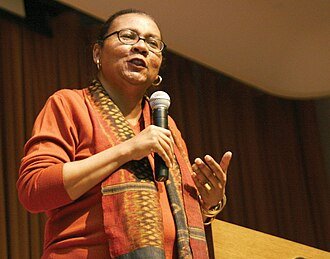 Authorbell hooks1952–2021
We Real Cool: Black Men and Masculinity is a 2004 book in which the feminist author bell hooks gathers ten essays on the masculinity of Black men in the United States. The title alludes to Gwendolyn Brooks's 1959 poem "We Real Cool." With it, hooks aims to offer both cultural criticism and possible ways out of the problems she identifies.
Her central claim is that Black men are forced to repress themselves in a white society that has criminalized and dehumanized them. According to hooks, the racist and sexist attitudes that developed in American culture have also harmed the Black community itself. To name the framework behind this, she uses the phrase "imperialist white supremacist capitalist patriarchy," and she considers that hip-hop, as a whole, strongly reflects that logic. The book takes issue with Ellis Cose's work and engages with the ideas of Malcolm X and W. E. B. Du Bois, while examining how patriarchy operated in family life, drawing on examples from her own father and brother, and calling for a radicalized intersectionality.
The chapters cover several areas. One looks at plantation patriarchy and gender relations under slavery, as well as the persistence of certain patriarchal models among Black men from the early twentieth century onward. Another addresses economic barriers, the equation of financial excess with the masculine ideal, and the turn toward sports, music and crime, with references to Muhammad Ali. A third deals with education and the discouragement of Black boys from reading. Another analyzes violence and the portrayal of Black men in film and the press, and the last considers sexuality, the legacy of myths about sexual prowess, and the need for a new kind of intimacy.
The book received mixed reviews. Some critics praised the author's skill and the force of her message, while others noted that the abundant quotations and the weight of feminist ideology partly diluted her arguments.
Themes
Other works by bell hooks
Original Filopedia text based on Wikipedia (en) and Wikidata.