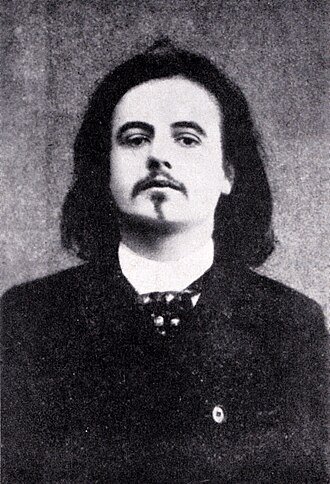
 AuthorAlfred Jarry1873–1907
Ubu Roi ("Ubu the King") is a play by the French writer Alfred Jarry, who was only twenty-three when he wrote it. It premiered in Paris on December 10, 1896, at the Nouveau-Théâtre on rue Blanche, staged by Aurélien Lugné-Poe's Théâtre de l'Œuvre. The single public performance caused a scandal: the protests of offended spectators were mixed with the cheers of avant-garde admirers, and the performance was halted several times. The reviews in the following days were largely scathing, although some members of the audience, among them W. B. Yeats, saw in it an event of revolutionary importance.
The play is a wild, grotesque and satirical farce about power, greed and the abuse of authority. Its protagonist, Captain Ubu, urged on by his wife, overthrows King Wenceslas of Poland with the help of Captain Bordure, and then rules through an absurd and brutal tyranny: he raises taxes to impossible levels, punishes merchants and nobles in order to seize their wealth, and makes corrupt use of his position. When Prince Bougrelas, the late king's son, returns with an army lent by the Tsar of Russia, Ubu leaves his wife in charge of the government and goes off to war, where he is defeated. The plot, full of killings, betrayals and pursuits, borrows motifs from Shakespeare's Macbeth, Hamlet and other plays, which it parodies.
Ubu himself is the centre of the work: a caricatured figure, fat, cowardly and self-absorbed, with a spiral drawn on his belly as a symbol of his limitless ambition. Jarry conceived him from the mockery that pupils at the lycée in Rennes directed at their physics teacher, Félix-Frédéric Hébert; the name derives from a distortion of that surname. The play is the first of three burlesques, followed by Ubu Cocu (Ubu Cuckolded) and Ubu Enchaîné (Ubu in Chains), neither of which was staged during Jarry's lifetime; he died at thirty-four.
Its influence was decisive. By breaking with dramatic conventions, using a deliberately vulgar and scatological language, employing masks and puppet-like staging, and rejecting realism in its sets and costumes, Ubu Roi is regarded as a forerunner of Surrealism, Dada and the Theatre of the Absurd, and as one of the works that opened the door to theatrical modernism in the twentieth century. The character has also become a recurring reference, adapted for the stage, opera, film and comics many times, and the adjective "ubuesque" is used to describe the grotesque and absurd side of power.
Themes
Books to read
- Ubu Roi, ou, les Polonais FrenchEPUB 107 KBRead online
Other works by Alfred Jarry
Original Filopedia text based on Wikipedia (es) and Wikipedia (en) and Wikidata.