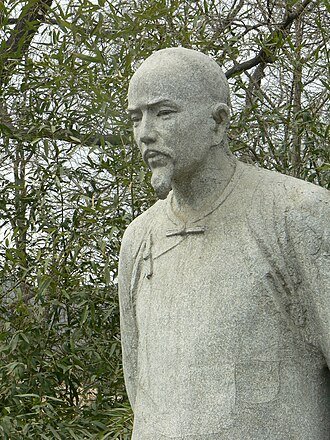
 AuthorCao Xueqinb. 1724
Dream of the Red Chamber, also known as The Story of the Stone, is a Chinese novel written by Cao Xueqin in the mid-eighteenth century, during the Qing dynasty. Cao began composing it in the 1740s and worked on it until his death in 1763 or 1764. The first eighty chapters circulated in hand-copied manuscripts among his friends and a growing circle of enthusiasts, under varying titles, before being printed nearly three decades after the author's death. The 1791–1792 edition, prepared by Gao E and Cheng Weiyuan, completed the work in 120 chapters, although the authorship of the last forty remains debated.
The novel is considered semi-autobiographical: it recounts the rise and decline of two branches of the powerful Jia clan, related to the author's own family, and by extension reflects the trajectory of the Qing dynasty. Cao also conceived it as a tribute to the women he had known in his youth, among them friends, relatives and servants. Its plot, rich in characters, follows daily life, rivalries, love affairs and social obligations among the aristocracy, with meticulous observation of customs, rituals, cuisine, medicine, music and poetry. Its frame story features a supernatural stone that longs to know the mortal world, and the interplay between reality and illusion runs through the entire work.
The book introduced a psychological depth unusual in traditional Chinese fiction: its characters are neither wholly good nor wholly bad, but human and contradictory. It is written in baihua, the vernacular, and its dialogue reproduces the Beijing Mandarin that became the basis of modern spoken Chinese. In the early twentieth century it served lexicographers and reformers in establishing the standard language and promoting written vernacular. It is one of the Four Great Classic Novels of Chinese literature, and the scholarly field devoted to it is known as Redology.
Themes
Original Filopedia text based on Wikipedia (es) and Wikipedia (en) and Wikidata.