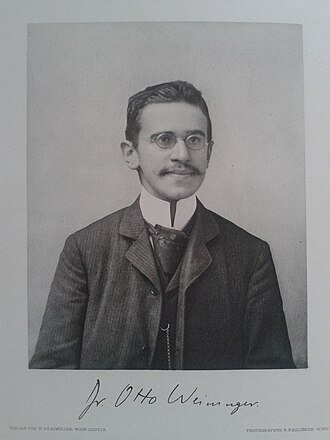
 AuthorOtto Weininger1880–1903
Sex and Character (Geschlecht und Charakter) is the main work of the Austrian philosopher Otto Weininger (1880–1903). It was published in Vienna in June 1903 by the publisher Braumüller & Co., a few months before its twenty-three-year-old author took his own life in October of that year. The book is a classic document of the Wiener Moderne, the intellectual milieu of late nineteenth- and early twentieth-century Vienna.
Its origins lie in two manuscripts that Weininger deposited with the Austrian Academy of Sciences in 1901 and 1902 to secure priority for his ideas, titled Eros und Psyche and Zur Theorie des Lebens. The first was presented to his professors as a doctoral dissertation, which earned him his doctorate in philosophy in 1902. The published version expanded that text with three crucial chapters: "The Nature of Woman and her Relation to the Universe", "Judaism" and "Women and Humanity". Weininger hoped Sigmund Freud would recommend the work to a publisher, but he did not.
The central thesis is that every human being combines male and female elements in varying proportions, with the masculine linked to consciousness, morality, logic and spirit, and the feminine linked to the unconscious, the sexual and the amoral. Weininger argued that the sexes attract one another according to complementary proportions, and proposed that the elevated individual should overcome his feminine part. At the same time, the book relies on misogynist and antisemitic claims that are now considered unfounded, and which Weininger himself tied together by equating the Jewish with the feminine.
The work did not receive the scandalous reception its author had hoped for, although it provoked debate. Paul Julius Möbius criticized it, and Weininger was accused of plagiarism. Over time it exerted considerable influence on Ludwig Wittgenstein, August Strindberg and, through other works, James Joyce. Its reception has been ambivalent: its speculative brilliance coexists with prejudices that history has judged severely.
Themes
Original Filopedia text based on Wikipedia (es) and Wikipedia (en) and Wikidata.