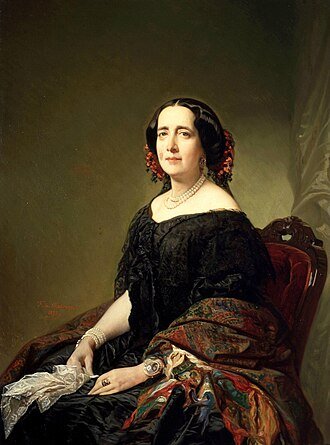
 AuthorGertrudis Gómez de Avellaneda1814–1873
Sab is a novel by the Cuban-born writer Gertrudis Gómez de Avellaneda, published in Madrid in 1841. It belongs to the Romantic period but already shows realist traits. The story takes place on a sugar plantation in the former jurisdiction of Puerto Príncipe, today Camagüey, halfway between the city and the village of Cubitas, around the late 1810s. The author began the work in Cuba and finished it in Spain, where she lived at the time, amid the political turbulence that followed the First Carlist War.
The protagonist is Sab, a mulatto slave who is educated, refined in spirit, and in love with Carlota, the white daughter of his master. Carlota, however, has set her affections on Enrique Otway, an avaricious English merchant who wants to marry her only for her dowry and her family's prestige. Sab's unrequited love becomes the vehicle for a broader denunciation of Cuba's slave system and the colonial society that sustains it. The title refers to the name his mother used for him; his real name was Bernabé.
The novel is divided into seventeen chapters, each introduced by a motto that sets the tone. It mixes description, dialogue, letters and dramatic monologues, and its third-person narration alternates between rapid and slow rhythms. The Cuban landscape, rendered in rich detail, plays a central role, and the text includes the typical concerns of Romantic fiction, such as nature, customs, legend and indigenous themes, along with a vocabulary full of Americanisms and Cubanisms.
The book sets two destinies for women against each other through Carlota and her sister Teresa. Carlota can only hope for a profitable marriage, while Teresa, unable to attract a suitor, ends up in a convent. The Otways embody the capitalist interest that exploits land and people, whereas the Bellavista family relates to money through the sugar plantations in a more natural way. Sab himself shows how an enslaved person can be treated as a mere instrument for someone else's ends.
The novel has been widely studied. It is considered one of the major works of nineteenth-century Cuban literature and the first anti-slavery novel published in the Spanish language. Some critics place it alongside the great European novelists of the period, though others note that Gómez de Avellaneda treats human dilemmas through everyday, dramatic situations rather than intellectual reflection. Readers have also emphasized its implicit critique of the repression of women in a patriarchal society and of racial prejudice. It was not published in Cuba until 1914.
Themes
Original Filopedia text based on Wikipedia (es) and Wikipedia (en) and Wikidata.