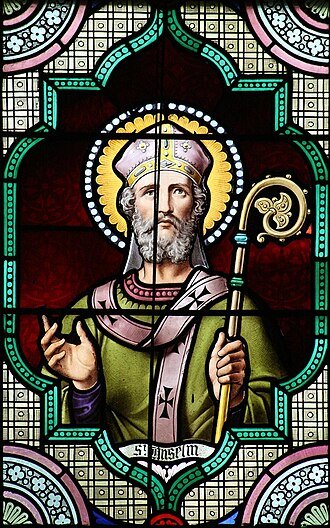
 AuthorAnselm of Canterbury1033–1109
The Monologion ("Soliloquy") is a theological treatise written in 1076 by the Benedictine monk and philosopher Anselm of Canterbury while he was prior of the abbey of Notre-Dame du Bec. It is Anselm's first philosophical work, and it was composed at the request of his disciples, who asked their master for a reflection on the existence of God built on strictly rational grounds.
Its aim is to demonstrate God's existence and to analyse his attributes without relying on revealed truths, using a posteriori arguments grounded in the experience of the sensible world and developed through reason. The work takes the form of an inner monologue: Anselm imagines a man who, ignoring or doubting the contents of the Bible, reflects on the properties of reality and discovers by reason a being with the characteristics of the Christian God.
The main arguments start from observations about goods, magnitudes and hierarchies of value: every desire aims at some good, so there must be a supreme good; in the same way, there must be greatness in itself and a being that exists through itself, without which the chain of causes would have no end. Every judgement of perfection presupposes a perfect standard, which is God. In this respect Anselm brings a broadly Platonic vision into Christian thought.
The work was criticised already in the Middle Ages, for instance by Pierre de Jean Olivi, who questioned the realism of essences and the idea that shared qualities exist beyond the mind. The weaknesses commonly pointed out include the so-called theory of participation, of Platonic origin, and the assumption that every thought corresponds to a reality. Nevertheless, Thomas Aquinas, although he challenged the proofs of the Proslogion, took up the arguments of the Monologion in his own demonstration of God's existence.
Themes
Other works by Anselm of Canterbury
- Proslogion 1078
- Cur Deus Homo 1098
Original Filopedia text based on Wikipedia (es) and Wikidata.