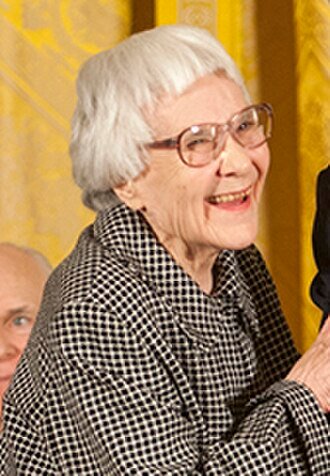
 AuthorHarper Lee1926–2016
To Kill a Mockingbird is a novel by the American writer Harper Lee, published in 1960. It was an immediate success: it won the Pulitzer Prize the following year and soon became a classic of American literature, widely read in high schools. Lee drew on her observations of her family and neighbors in Monroeville, Alabama, and on an incident near her hometown in 1936, when she was ten years old.
The story unfolds over three years of the Great Depression in the fictional town of Maycomb, also in Alabama. The narrator is Scout Finch, a young girl who lives with her older brother, Jem, and their widowed father, Atticus, a middle-aged lawyer. Scout, Jem and their friend Dill are both frightened and fascinated by their reclusive neighbor, Boo Radley, whom the adults avoid discussing and around whom the children spin rumors and devise schemes to coax him out of his house. Gradually, small gifts left in a tree near the Radley home suggest that Boo is watching over them with affection, although he never appears in person.
At the heart of the novel is the case of Tom Robinson, a Black man accused of raping a young white woman, Mayella Ewell. Atticus agrees to defend him despite the hostility of much of the town, and his children suffer taunts from other kids as a result. Atticus makes it plain that the accusations are false, yet the jury finds Tom guilty. Jem's faith in justice is shattered when Tom, desperate, tries to escape from prison and is shot dead. Mayella's father, Bob Ewell, humiliated by the trial, vows revenge against Atticus and the children, and the novel builds to an attack that leaves Jem injured and to a rescue that reveals the identity of the mysterious helper.
The book is both a Southern Gothic novel and a coming-of-age story, in which the children's loss of innocence is intertwined with the chronicle of racial injustice and of class and gender tensions in the Deep South. Its moral center, Atticus Finch, has become one of the most admired characters in American fiction, a model of integrity for readers and lawyers alike, though critics have pointed out that Black characters are less fully developed than white ones, which has led some Black readers to respond to the novel with ambivalence.
Its reception was varied. Literary analysis has been relatively sparse compared with the book's sales and its use in schools, and it has also been the target of campaigns to remove it from classrooms because of its racial slurs. Even so, its influence has been lasting: a 1962 film directed by Robert Mulligan, with a screenplay by Horton Foote, won three Academy Awards, and since 1990 a stage adaptation has been performed every year in Monroeville. A 2015 release, Go Set a Watchman, presented an earlier draft that depicts Scout's childhood, but To Kill a Mockingbird remains the work for which Harper Lee is remembered.
Themes
Other works by Harper Lee
- Go Set a Watchman 2015
Original Filopedia text based on Wikipedia (es) and Wikipedia (en) and Wikidata.