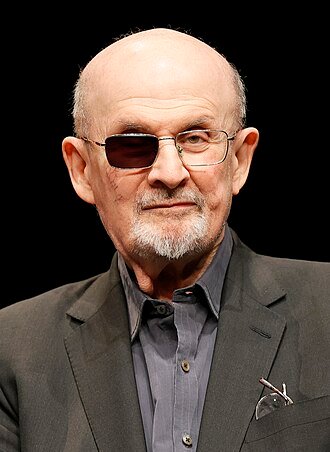
 AuthorSalman Rushdieb. 1947
The Satanic Verses is the fourth novel by the British-Indian writer Salman Rushdie, published in 1988. It draws in part on the life of the Prophet Muhammad and, as in his earlier books, combines magical realism with contemporary events and people to build its characters. The title refers to a group of Quranic verses that mention three pre-Islamic goddesses of Mecca: Allāt, Al-‘Uzzā and Manāt. According to a tradition recorded in Ibn Ishaq's biography of Muhammad, the Prophet mistook words of supposed satanic inspiration for a divine revelation, and the novel's section on these verses rests on accounts by the historians al-Waqidi and al-Tabari.
The main storyline follows two actors of Indian origin. Gibreel Farishta is a Bollywood star who specialises in religious roles; Saladin Chamcha is an emigrant who has rejected his Indian heritage and works as a voice actor in England. The two survive, almost miraculously, the explosion of the plane carrying them from India to Britain, and in the air they are transformed: Farishta takes on traits of the archangel Gabriel, and Chamcha those of a devil. This thread is interwoven with Farishta's dream visions, among them a retelling of the life of Muhammad, called Mahound, in the city of Jahilia, and the story of a village girl who leads her community on a pilgrimage that ends in disaster. A third vision portrays an exiled religious leader in the West, a figure recalling Khomeini.
The novel received broadly favourable reviews. It was a finalist for the 1988 Booker Prize, losing to Peter Carey's Oscar and Lucinda, and won that year's Whitbread Award for Novel of the Year. Critics have praised it as a study of alienation, identity and rootlessness among migrants, and as a satire of Western materialism, with influences ranging from Joyce and Kafka to Bulgakov.
Its publication provoked a worldwide controversy. Many Muslims regarded the book as blasphemous and its author as an apostate. In February 1989, Ayatollah Khomeini, Supreme Leader of Iran, issued a fatwa calling for the execution of Rushdie and of those involved in publishing the book. Protests, book burnings and bans followed in several countries, and several translators and publishers were attacked; the Japanese translator Hitoshi Igarashi was killed. Rushdie lived under police protection for years. In August 2022 he survived a stabbing attack carried out in an attempt to carry out the fatwa.
Original Filopedia text based on Wikipedia (es) and Wikipedia (en) and Wikidata.