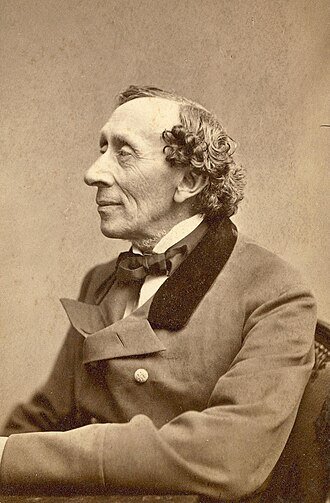
 AuthorHans Christian Andersen1805–1875
The Little Mermaid is a fairy tale written by the Danish author Hans Christian Andersen, best known for his stories for children. He wrote it in 1836, and it first appeared on 7 April 1837 in Copenhagen, in the third volume of his collection Fairy Tales Told for Children. Andersen republished it in 1849 with illustrations by Vilhelm Pedersen, and again in 1862 as part of his collected stories.
The story follows the youngest daughter of the Sea King, who lives with her five older sisters and her grandmother in an underwater kingdom. When she turns fifteen she swims to the surface for the first time and falls in love with a prince, whom she rescues from drowning in a storm. Driven by that love and by the wish for an immortal soul, which mermaids do not possess, she visits the Sea Witch. The witch gives her legs in exchange for her voice, on the condition that she will gain a soul only if the prince loves her and marries her. The tale then moves through the mermaid's physical suffering, her silence, and the prince's indifference, as he marries another young woman, toward an ending in which the mermaid refuses to kill him to regain her life at sea and dissolves into sea foam.
The story nonetheless departs from the tragedy its plot seems to point toward. After death, the protagonist becomes a daughter of the air, a spirit who can earn a soul through good deeds over three hundred years. This ending, with its blend of sacrifice and hope, has been much debated. The writer P. L. Travers criticized the system of rewards and punishments presented to children, while scholars such as Jacob Bøggild and Pernille Heegaard have read the turn as a deliberate choice by Andersen, closer to ambiguity than to religious sentimentality. Others, such as Søren Baggesen and James Massengale, consider it a natural part of the story's structure as a religious narrative.
The work has had considerable influence. Andersen drew in part on Undine by Friedrich de la Motte Fouqué, though he judged his own resolution to be the better one. It has been adapted to ballet, opera, musical theatre, animated film and live action, and it inspired the symphonic poem Die Seejungfrau by Alexander von Zemlinsky. A statue of the mermaid stands in Copenhagen, where it has become one of the city's emblems.
Themes
Other works by Hans Christian Andersen
- Thumbelina 1835
- The Princess and the Pea 1835
- The Tinderbox 1835
- The Emperor's New Clothes 1837
- The Steadfast Tin Soldier 1838
- The Swineherd 1841
- Ole Lukøje 1841
- The Snow Queen 1844
- The Little Match Girl 1845
- The Ice-Maiden 1861
- The Ugly Duckling
Original Filopedia text based on Wikipedia (es) and Wikipedia (en) and Wikidata.