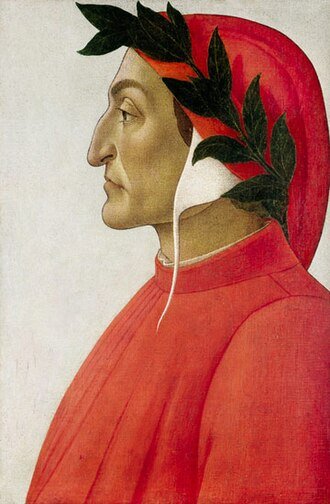
 AuthorDante Alighieri1265–1321
The Divine Comedy is a poem written by Dante Alighieri in the Tuscan dialect, the basis of modern Italian. The exact date of composition is unknown, but it is usually placed between the early fourteenth century and the poet's death in 1321: Inferno is thought to have been written around 1304-1308, Purgatorio around 1307-1314, and Paradiso between 1313 and 1321. Dante simply called it Comedy, since by the classical scheme a work with a happy ending could not be a tragedy. The adjective "divine" was added by Giovanni Boccaccio, who read and lectured on the poem publicly in several Italian cities, and later tradition fixed it in the title.
The poem recounts a journey through the three realms of the afterlife: Hell, Purgatory and Heaven. The protagonist, Dante, finds himself lost in a dark wood at the midpoint of his life and is guided first by Virgil, the Roman poet who stands for human reason, then by Beatrice, his ideal woman and a figure of faith, and finally by Saint Bernard of Clairvaux, who accompanies him in the last cantos. Each realm has thirty-three cantos, with an additional introductory canto, making one hundred in all. The punishments of the damned follow the law of contrapasso, by which a penalty symbolically mirrors the sin committed. The work reflects the medieval worldview, rooted in theology and philosophy, while also pointing towards a more human-centred outlook.
The poem is built with great numerical precision. The number three, associated with the Trinity, governs its organisation, and the verse form, terza rima, consists of linked tercets of hendecasyllables. Dante moves between the colloquial language of Hell and the biblical quotations and hymns of Purgatory and Paradise. Its political dimension is also prominent: his exile from Florence in 1302, after the struggle between the White and Black Guelphs, runs through the poem in prophecies, judgements on contemporaries and a longing for an imperial power that might restore order in Italy.
The Divine Comedy is regarded as the masterpiece of Italian literature and one of the summits of world literature. It lent prestige to Tuscan as the foundation of the Italian language, influenced generations of poets and artists, and has been illustrated by figures such as Botticelli, Doré, Blake and Dalí.
Themes
Books to read
- The divine comedy EnglishEPUB 481 KBRead online
- La Divina Comedia SpanishEPUB 496 KBRead online
- The Divine Comedy by Dante, Illustrated, Purgatory, Complete EnglishEPUB 199 KBRead online
- The Divine Comedy by Dante, Illustrated, Paradise, Complete EnglishEPUB 194 KBRead online
- The Divine Comedy, Volume 1, Hell EnglishEPUB 212 KBRead online
- The Divine Comedy of Dante Alighieri: The Inferno EnglishGutenberg
Other works by Dante Alighieri
- La Vita Nuova 1295
- De vulgari eloquentia 1303
- Convivio 1304
- De Monarchia 1316
- Eclogues 1719
- Le Rime
Original Filopedia text based on Wikipedia (es) and Wikipedia (en) and Wikidata.